Get Full Government Meeting Transcripts, Videos, & Alerts Forever!
Get email alerts on the Legal Framework topic
No spam. Unsubscribe anytime.
Legal counsel outlines legislative and quasi‑judicial standards for Bonita Springs council
Summary
City legal counsel David Goldwyn told the council that it must wear separate 'legislative' and 'quasi‑judicial' hats: legislative decisions allow broader discretion, while quasi‑judicial matters require a record based on competent substantial evidence and strict disclosure rules.
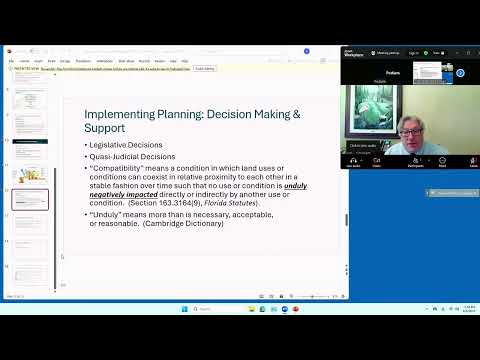
David Goldwyn, the city’s legal counsel, told the Bonita Springs City Council at a March workshop that the council operates under two distinct decision‑making standards. "There are two hats that the city council wears," Goldwyn said, "the legislative hat when you're making a legislative decision, and there's a quasi judicial hat when you're making a quasi judicial decision."
Goldwyn said legislative actions—such as adopting a comprehensive plan or land‑development code—allow broader discretion: council members may discuss policy with constituents and applicants, and courts review denials under a deferential "fairly debatable" standard. "If you deny a comprehensive plan amendment, the lawsuit challenging a denial is what's known as a trial de novo," he said, describing that process as a new, non‑jury trial with live testimony.
By contrast, Goldwyn said quasi‑judicial decisions (rezonings, development orders) must be based on "competent substantial evidence." He explained that quasi‑judicial hearings require sworn testimony, cross‑examination and disclosure of any communications outside the hearing because appellate review in such cases is limited to the record. "We have to focus on making sure we create that record," he said.
Goldwyn walked the council through practical examples of what qualifies as admissible evidence in quasi‑judicial matters: factual observations from neighbors (numbers of homes, building heights) can be competent evidence, while expert opinions (traffic engineering, appraisal of property values) generally require qualified witnesses. He urged council members to tie denials to specific provisions of the comprehensive plan or the land‑development code so decisions will withstand judicial review.
On the topic of "compatibility," Goldwyn read from the statutory definition and emphasized the importance of objective criteria—building heights, use types, massing, noise and lighting—while noting the crucial qualifier in the statute that compatibility concerns impacts that are "unduly" harmful. "Some level of a negative impact is acceptable," he said, "it's only when that negative impact rises to the level of being unreasonable or unacceptable that the proposed use would not be compatible."
Goldwyn used a recent 2023 case the city litigated as an illustrative example of the differing standards and how courts evaluate legislative denials, and he advised staff and council to create and preserve a clear record in quasi‑judicial proceedings. He also suggested staff and council consider items to propose for a future state 'glitch bill' to address statutory or procedural issues at the legislature.
Next steps: staff indicated they will provide additional analytical tools and follow‑up briefings so the council can apply the guidance to forthcoming land‑use cases.