Get Full Government Meeting Transcripts, Videos, & Alerts Forever!
Get email alerts on the Cell Phone Policy topic
No spam. Unsubscribe anytime.
Principals say new cell-phone limits increased classroom focus and lunchtime interaction
Summary
Middle- and high-school principals told the Grandview Heights Schools board that a district cell-phone policy has reduced phone-related disruptions, improved student interactions at lunch and generally won staff and family support, though student survey response rates were low and some families raised emergency-contact concerns.
Middle- and high‑school principals told the Grandview Heights Schools board on Monday that a new district policy limiting student cell‑phone use is reducing classroom disruptions and encouraging more in‑person interaction among students.
Superintendent Lisa Sullivan introduced the update and said the board asked principals to report back after four months of implementation. Middle school principal Sean Hinkle said staff surveys showed roughly 70% support for the policy and that office staff had seen far fewer social‑media incidents this school year. "So far this school year, we've had one instance," Hinkle said, citing a social‑media issue that occurred at a Friday night football game.
Hinkle said classroom and lunchtime observations show more student engagement: students are communicating with peers and seeking help from staff rather than texting parents or others. He attributed fewer disruptions during class to phones being secured in lockers or stored during class periods. Hinkle added that Chromebook use in classrooms has not increased in a way that undermines instruction; teachers still use Chromebooks for some activities but report smoother transitions and more time on curricular tasks.
High school principal Sam Belk said the high school implemented cell‑phone caddies for academic periods and allows access during study halls and lunch. He described planning and outreach that began in 2022–23, and partial survey results: about 23% of high‑school students responded and many reported that the policy "creates an environment for more interaction" and reduced anxiety. "We are not the fun police," Belk said when describing how staff framed the change to students.
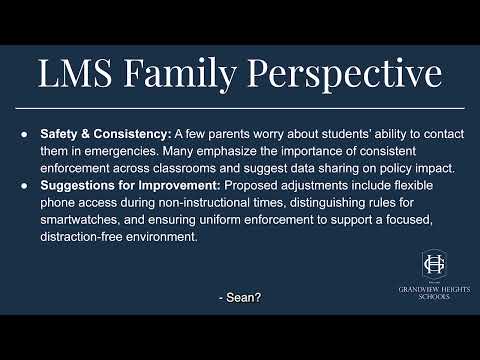
Both principals noted mixed student survey responses and low response rates that limit how conclusive the data are. Hinkle said about 12% of the seventh‑ and eighth‑grade students targeted for the survey responded (approximately 20 students). Family survey responses were roughly 60 responses from a population of 277 students (about 10–20% response rate); families generally reported improved focus but some asked for clearer emergency‑contact procedures. Hinkle said offices and clinics have phones available for true emergencies and the district has made accommodations for students who rely on smartwatches for medical reasons.
Board members asked several operational questions — for example whether smartwatches can be used to contact families, whether apps can be blocked on district Wi‑Fi, and how Chromebook use intersects with the policy. Belk and Hinkle said watches have created similar contact issues in some cases and that Wi‑Fi filters already block social‑media sites on school devices; students can still access content via cellular networks. The board asked staff to prepare additional guidance on headphones and to arrange a future presentation on Chromebook use and how district devices interact with emerging AI tools.
The board did not take further action on the policy at the meeting; principals said they will continue to monitor implementation and report back.