Get Full Government Meeting Transcripts, Videos, & Alerts Forever!
Get email alerts on the Wave Energy topic
No spam. Unsubscribe anytime.
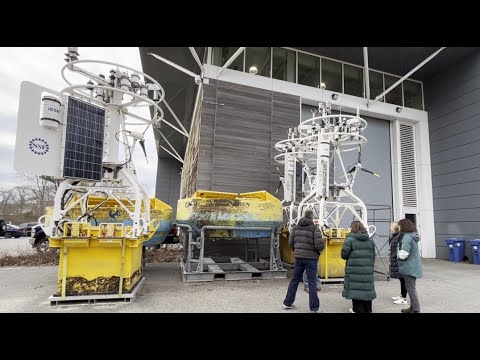
Sandia National Laboratories developing wave energy converter for NSF’s Pioneer Array, presenter says
Summary
A presenter said Sandia National Laboratories is developing a wave energy converter to add electrical power to buoys in the National Science Foundation’s Pioneer Array, aiming to supplement wind and solar, address durability challenges and pursue deployment within about a year.
A presenter said Sandia National Laboratories is developing a wave energy converter (WEC) intended to provide supplemental electrical power to buoys in the National Science Foundation’s Pioneer Array, which currently relies on wind and solar.
The presenter said the WEC is intended to generate electricity from the buoys’ pitching and rolling motion. "The wave energy converter is designed to generate electricity for the buoys within the Pioneer array based on its pitching and rolling motion," the presenter said. The presenter added that "if consistent, even a relatively small amount of power can provide substantial benefit to the autonomous power demands such as this." These benefits, the presenter said, would improve the buoys’ ability to carry out ocean-observation science.
A staff member on the project described technical resources and partners. The staff member said Sandia is relying on existing expertise — including robotics, design and fabrication — and is partnered with Woods Hole and the National Science Foundation, and said the team is using the National Renewable Energy Laboratory’s large amplitude motion platform (LAMP) for testing. "LAMP had 6 degrees of freedom so it was rocking back and forth at all different angles and speeds and so we had to ensure that the system was gonna be able to act accordingly to all those different motion," the presenter said, summarizing the testing contrast with simpler motion rigs.
The staff member also stressed ocean deployment durability: the device is expected to oscillate at about 0.3 hertz (about one cycle every three seconds) and, over a roughly six-month deployment window, would undergo "millions of cycles," a condition that influences design and materials choices. The presenter said the current design will be iterated and refined and that the Pioneer Array’s scheduled deployment windows determine when the team can place hardware at sea; the team hopes to have a device deployed within about a year.
No formal funding amounts, deployment dates, or specific instrument-level performance numbers were provided during the briefing. The presenters identified partners and testing platforms but did not provide additional administrative details or a firm launch date.