Lifetime Citizen Portal Access — AI Briefings, Alerts & Unlimited Follows
Sandia National Laboratories outlines microgrid, cybersecurity and hardware testing to bolster grid resilience
Loading...
Summary
Researchers from Sandia National Laboratories described laboratory tools and research aimed at securing the electric grid, emphasizing microgrids for local reliability, simulated cybersecurity testing for operational technology, and hardware-in-the-loop experiments to evaluate device behavior before field deployment.
Sandia National Laboratories researchers described steps to strengthen electric-grid resilience, highlighting microgrids, cybersecurity simulation and hardware-in-the-loop testing. "Sandia National Laboratories is at the forefront of these efforts, contributing important discoveries in support of a more secure energy future," a presenter said.
The presenters framed the challenge as balancing growing capacity needs with increasing distributed resources and new threats. "The next century will result in energy transformations we can't yet imagine," the presenter added, saying the laboratory is pursuing innovations to make the grid "safe, secure and reliable."
On microgrids, a presenter defined them as "on-site electrical power systems that utilize local generation rather than relying on large centralized plants" and noted they can operate either connected to the main grid or isolated when necessary. The talk listed common microgrid resources — solar panels, batteries and, in some cases, gas generation — and gave Alaska as an example where some isolated communities rely exclusively on microgrids.
Presenters said electrical systems with high shares of distributed resources can experience wide voltage deviations and variable active power flows; those inconsistencies, they said, require near-instantaneous response and efficient devices to maintain system stability.
On cybersecurity, a Sandia presenter said the laboratory can simulate real-world environments where devices are installed in order to "identify and find cyber vulnerabilities as it affects these devices within operational technology or OT," and to disclose vulnerabilities discovered through that research. The presenters stressed testing in a laboratory environment because active grids cannot accommodate the risks associated with some experiments.
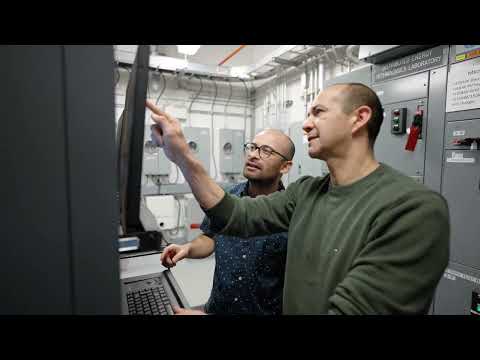
The team also described hardware-in-the-loop testing: connecting actual physical equipment to a simulated power grid so researchers can study device responses safely. "We test actual physical equipment because there are no active electric grids that can accommodate the risks associated with testing new devices," one presenter said, describing the approach as a way to validate innovations before field deployment.
The presentation closed with a statement of institutional commitment: by addressing difficult challenges facing the electric system, Sandia's distributed energy technology lab is working to make the grid more resilient and reliable.
The remarks were descriptive of research capabilities and did not announce specific policy actions or regulatory decisions.