Albemarle school budget work session: county raft would divert $6.4M to capital, creating a $2.3M recurring gap
Loading...
Summary
Albemarle County Public Schools staff told the board the county executive—udget recommends redirecting $6.4 million of next year—unding to the county capital improvement program, reducing the school division—Y27 projected revenues and leaving a $2.3 million recurring gap to close; staff outlined where the cuts could come from and committed to follow-up detail.
Albemarle County Public Schools staff outlined the division—Y27 funding request and warned that a county executive recommendation would divert $6.4 million of shared local revenue into the county—apital improvement program, reducing the division raft funding request and creating a $2.3 million operating gap.
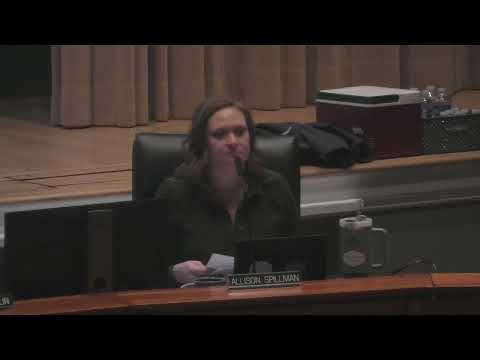
"That leaves $28,480,000 in shared revenues available for the split," Maya Kumazawa, director of budget and planning, told the board during a Feb. 26 work session. Kumazawa said the county proposal keeps a one-time $6.4 million transfer to the Board of Supervisors' CIP placeholders while still increasing the transfer to schools in other respects, resulting in a net $6.4 million reduction to the division's projected revenues.
Kumazawa said the county's recommended change is presented as a two-year action to build capacity for significant school facility needs and to hedge against potential future changes to the local composite index, which affects state funding. The board—unding request still projects $311.3 million in expenditures; with the $6.4 million reduction the staff—stimated anticipated revenues would be about $304.9 million.
Board members pressed staff on impact and next steps. Kumazawa said part of the $6.4 million was planned as a one-time transfer to school capital and $2.3 million of the amount would affect recurring operations that the division has not yet specifically allocated. "The remaining $2,300,000 is you could allocate it to what you perceive the budget," she said, adding staff will return with options for addressing the operating gap.
Directors also asked for follow-up data on class-size and staffing assumptions tied to the division's FTE projections and to confirm how the proposed changes would affect openings of two new buildings. Kumazawa pointed the board to pages in the budget book that outline net new FTEs (74.6 added in the school fund) and said the cost to open the new buildings is largely FTE-driven (roughly $2.1 million per new building in the draft book).
The presentation listed the rationale the county gave: (1) significant identified school facility needs in the CIP, (2) a desire to move operating dollars into capital to advance construction and renovations, and (3) preparation for potential future unfavorable movement in the local composite index that could reduce state revenues.
Kumazawa told members staff will bring a state revenue update when the conference budget is available, a detailed second-quarter financial report and updated fund balance projections, and a narrower set of options for closing the $2.3 million recurring gap before the board pproves its final funding request next week.
What happens next: the board asked staff to return with detailed breakdowns of the $2.3 million recurring amount, the projected FTEs tied to new schools, and a state revenue update before the board finalizes its funding request.