
Baltimore tenants and advocates press council to pass expanded rental licensing and receivership authority
Get AI-powered insights, summaries, and transcripts
Subscribe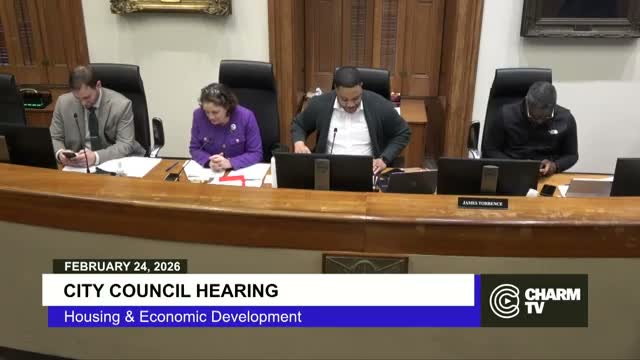
Summary
Councilwoman Odette Ramos’s Rental Dwelling Health and Safety Enforcement Act (25-0141) drew hours of public testimony at a City Council committee hearing, with tenants, legal advocates and agencies debating receivership, inspector accountability, audits of licensed units and costs of implementation.
The Housing and Economic Development Committee heard hours of public testimony on Council Bill 25-0141 on Feb. 26, as Councilwoman Odette Ramos outlined a package of reforms intended to tighten Baltimore City’s rental licensing program and give the city stronger tools to address unsafe housing.
Ramos said the bill would expand licensing to all rental units, create a rental-property receivership option for the most egregious owners, require audits of up to 100–200 licensed units, require additional ownership disclosure on the licensing portal, condition licenses on payment of outstanding water bills in some cases, prohibit landlords from threatening to report tenants to immigration authorities and require training for property managers of buildings with 20 or more units. "If you threaten to call ICE on our residents, we will revoke your license," Ramos said.
Why it matters: More than half of Baltimore’s housing stock is rented, testimony and sponsor remarks said, and advocates argued current licensing practices have left many unsafe units on the market. Supporters said stronger enforcement and transparency would give tenants a path to repair and protection from retaliation. Opponents and city agencies warned the city must design workable administrative systems and consider fiscal costs.
Tenant testimony and coalition support. Dozens of tenants and tenant advocates described long delays in repairs, rodent and mold infestations, alleged landlord intimidation and instances where properties were licensed despite unsafe conditions. Sarah Hollins described living with leaks, electrical problems and mold and said she had learned her landlord had never been licensed. "I am a current victim of landlord intimidation," she said. Multiple speakers singled out buildings such as Harvey Johnson Towers and recounted fires, carbon monoxide exposure and alleged retaliation when tenants attempted to complain.
Legal and public-health advocates urged the council to preserve the receivership tool and tighten licensing scrutiny. Ruth Ann Norton of the Green and Healthy Homes initiative said stronger enforcement had driven down childhood lead poisoning in past efforts and pointed to a prior case involving invalid lead certificates as evidence that the city needs more checks on licensing and inspection processes.
Agency concerns and technical questions. City agencies broadly supported the bill’s goals but raised operational and legal concerns. Hillary Ruhly of the city law department recommended a set of conforming amendments (she listed 13 proposed edits) and warned that some drafting choices could conflict with state licensing or would need clearer definitions—most importantly clarifying what counts as an "attempt" to remedy violations and how receivership should be triggered. Alice Kennedy, Housing Commissioner at DHCD, said receivership is the city’s highest enforcement tool and urged precise language so courts would have the information they need. DHCD also asked for clarity on vacate/relocation authority and how the city would recoup relocation costs.
Financial and implementation questions. Gabriel Stewart Sikwitz of the Department of Finance said implementation of the bill as drafted would create substantial fiscal and staffing costs; his initial estimate—about $1.7 million annually—drew committee questions and a pledge to refine the calculation. Committee members and agencies discussed alternatives, and officials clarified that audits of 100–200 units could be handled with as few as two to three inspectors over a year, depending on workflow and office support. Committee members asked for a historical staffing and cost analysis from 2019, when the city previously employed in-house inspectors for some multifamily work, and requested follow-up fiscal scenarios showing fee adjustments to make the program cost-neutral.
Inspector accountability and fraud prevention. The bill would create a city registry of rental inspectors and seek to reduce conflicts of interest that arise when landlords repeatedly use the same private inspectors. Law department counsel and DHCD noted limits set by state licensing for home inspectors; the committee discussed several enforcement options if an inspector’s work appears fraudulent, including paying for reinspection, administrative referral to state licensing boards, or affirmative litigation.
Operational details and data access. Council members prioritized making ownership and responsible-party contact information available in the rental portal so tenants can identify who to contact. Ramos said she had included an audit provision to permit DHCD to check whether licensed units actually meet standards, and DHCD said it would work with BCIT and other agencies to make contact fields required on the online application. The bill’s water-bill language will likely be phased (the sponsor said some provisions would fall in a later "phase 2") to allow DPW and DHCD time to build technical connections.
What’s next. Ramos said the committee will not vote on the bill at this hearing but will hold additional work sessions to refine amendments and operational details. "We need to pass this bill for our residents to have safe, decent, affordable places to live," she said. Chair James Torrance committed to convening follow-up sessions and asked stakeholders to submit amendment ideas in writing.
Key quotes
"If you threaten to call ICE on our residents, we will revoke your license." — Councilwoman Odette Ramos.
"We stand by our bill report, but we have not reviewed the amendments in full and have concerns about duplicating condemnation processes in a way that may not produce faster results or guarantee just compensation." — Alice Kennedy, DHCD.
"It took 275 days for DHCD to revoke a license at one property under litigation," — Zafar Shah, Maryland Legal Aid, citing enforcement delay concerns.
Ending: The committee recessed with a commitment to further work sessions and additional fiscal and legal analysis before the council will consider a vote on the measure.