Get Full Government Meeting Transcripts, Videos, & Alerts Forever!
Get email alerts on the Evidence Based Public Health topic
No spam. Unsubscribe anytime.
NLM Region 4 webinar teaches librarians and public-health workers to build PICO questions and find evidence in PubMed, Health Evidence and the Community Guide
Summary
David Brown of the National Library of Medicine Region 4 led a training webinar showing how librarians and public-health practitioners can use PICO question framing and searches in PubMed, Health Evidence and the Community Guide to locate systematic reviews and other evidence for program design.
David Brown, an engagement specialist for Region 4 of the Network of the National Library of Medicine, led a webinar demonstrating how librarians and public-health practitioners can use PICO question framing and three online resources—PubMed, Health Evidence and the Community Guide—to find higher-quality research to guide interventions.
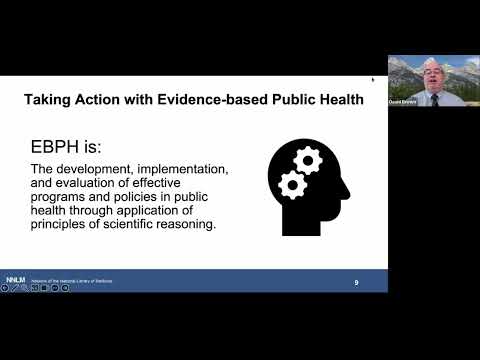
Brown said evidence-based public health "is the development, implementation, and evaluation of effective programs and policies in public health through appropriate application of principles of scientific reasoning," and argued practitioners should prioritize research over anecdote when planning programs and applying for grants. He emphasized that using evidence can improve program outcomes and demonstrate return on investment to funders.
The session covered three practical skills. First, Brown reviewed the PICO framework (patient/population/problem, intervention, comparison/control, outcome) and noted PIO or PNO variations are acceptable for many public-health questions. Using a class exercise about low cancer-screening rates among multilingual refugee and immigrant communities, he identified the population (multilingual refugees and immigrants), the intervention (a community health worker program), the comparison (no program) and the outcome (increased screening rates).
Second, Brown demonstrated searches in PubMed (pubmed.gov). He ran a sample query—"immigrant cancer screening community health workers"—which returned roughly 59 results in his configuration, then showed filters for recent publication dates (commonly the last five years), language limits, and links to free full text or PubMed Central (PMC) where available. He pointed out that systematic reviews and meta-analyses are especially valuable but can be harder to find; in the demo he identified at least one systematic review among the search results.
Third, Brown showed how to use Health Evidence (a Canadian evidence database discussed in the session) and the Community Guide (now maintained by the Centers for Disease Control and Prevention). He noted Health Evidence provides quality appraisals and economic summaries for reviews, while the Community Guide offers topic-specific syntheses (Brown found multiple systematic-review entries for cancer-screening interventions, including colorectal, cervical and breast cancer guidance).
Throughout the training Brown linked these tools back to accreditation and decision-making: he said the Public Health Accreditation Board's domain on evaluation and research (domain 9) expects agencies to use and contribute to evidence that supports public-health programs. He also stressed that planning should weigh three domains—practitioner expertise, community needs/politics/economics, and the best available research—to design interventions appropriate to local context.
Rebecca, identified only by first name in the chat, posted resource definitions and assisted with the live demonstration.
Brown closed with three takeaways: use the three domains of influence, follow the seven-step evidence-based public-health process, and prioritize PubMed, Health Evidence and the Community Guide when seeking high-quality research. He said the webinar was being recorded and the recording and handouts would be posted within about a week; he also referenced a separate PubMed class scheduled for Wednesday.
The session focused on practical search techniques and question-building for evidence-informed program design rather than on policy decisions or formal actions. Attendees were invited to contact their regional medical library for further training and support.