Get Full Government Meeting Transcripts, Videos, & Alerts Forever!
Get email alerts on the Special Education Pda topic
No spam. Unsubscribe anytime.
Bellevue School District coach urges low‑arousal, collaborative strategies for children with PDA
Summary
Michelle, a special education coach with Bellevue School District, led a parent webinar explaining pathological demand avoidance (PDA) as a profile linked to anxiety and proposed the PANDDA framework — prioritize, anxiety management, negotiation, disguise/manage, adaptation — plus low‑arousal approaches and resources for families.
Michelle, a special education coach with Bellevue School District, told parents in an online webinar that pathological demand avoidance (PDA) is best understood as a profile often linked to anxiety rather than as willful misbehavior. “PDA is absolutely not caused by your parenting,” she said, urging caregivers to shift from insisting on compliance to building trust and safety.
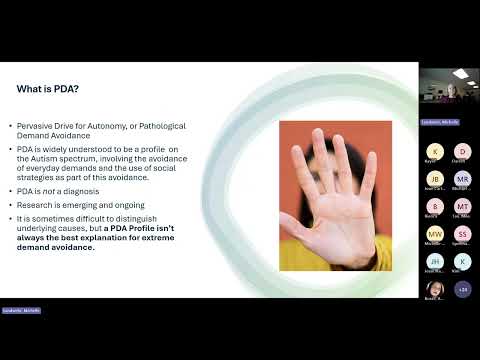
The presentation, aimed at caregivers and educators, combined lived‑experience material and practical strategies. Michelle described PDA as a profile on the autism spectrum that is not in the Diagnostic and Statistical Manual of Mental Disorders and said research is still evolving. She summarized key features — a hyper‑reactive threat response, masking, intense mood swings and frequent use of social strategies to avoid demands — and framed meltdowns as panic responses rather than deliberate opposition.
Why it matters: caregivers and school staff often misread PDA behaviors as defiance, which can lead to punitive responses that worsen outcomes, Michelle said. She cited caregiver surveys and recent research indicating limited recognition of PDA and a high rate of reported parental blame and isolation.
Practical takeaways and framework Michelle presented a mnemonic she called PANDDA to organize strategies. She described the elements as: prioritize and compromise (strip back to essentials and offer meaningful choices); anxiety management and low‑arousal approaches (calm voice, reduce uncertainty, manage environment); negotiation and collaboration (share decisions, use declarative language); disguise and soften demands (reframe requests, reduce direct instructions); and adaptation (use novelty, role play, plan B/C). “Treat panic like panic — it’s not misbehavior,” she said.
She emphasized caregiver regulation as a precondition for effective support, recommending peer support, accessible provider training and concrete wellbeing practices for parents. Michelle urged avoiding common responses that often fail for PDA profiles, listing consequences, punishment and lecturing among approaches that are frequently counterproductive.
Resources and next steps Michelle recommended Lives in the Balance and a recorded training by Dr. Ross Greene available through the Office of Superintendent of Public Instruction (OSPI) and said she had posted links in the meeting chat. Attendees were directed to send resource requests to specialedservices@bsd405.org so the district can forward materials. She also said organizers hope to offer a follow‑up session focused on school‑based strategies.
The session closed with attendees asking for a part 2 and sharing books and supports in the chat; Michelle remained available briefly after the recording ended to let participants copy resource links.