
Committee reviews LCCMRs $103.3 million recommendations, debates community grants amendment
Get AI-powered insights, summaries, and transcripts
Subscribe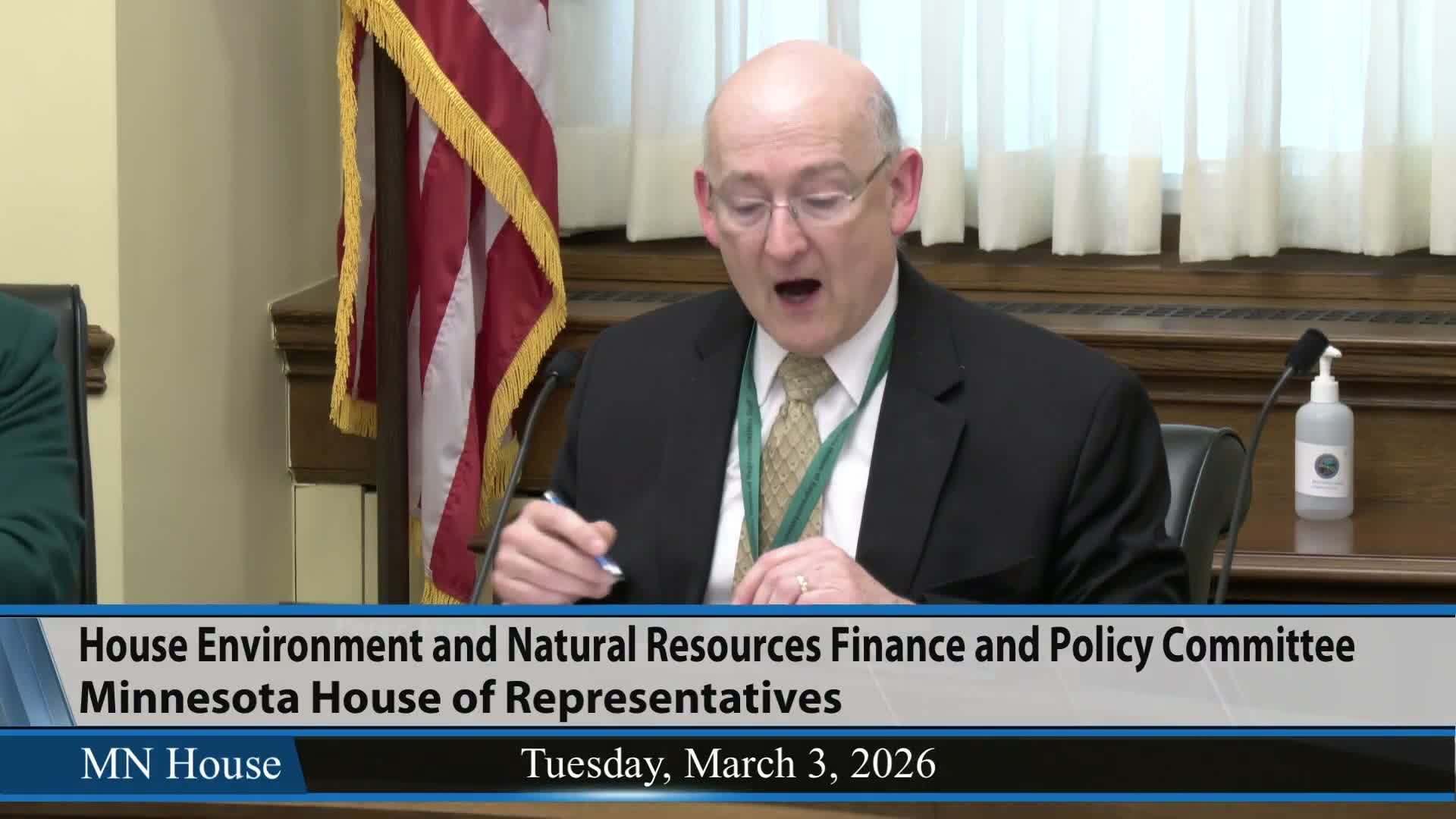
Summary
The House Environment, Natural Resources, Finance and Policy Committee heard presentations on House File 3426, which would appropriate $103.3 million recommended by the Legislative-Citizen Commission on Minnesota Resources (LCCMR) for 109 projects. Members questioned oversight and reimbursement processes and discussed, but did not take up, an amendment to authorize $28.18 million for a new DNR community grants program.
Representative Jordan moved House File 3426 before the Environment, Natural Resources, Finance and Policy Committee on March 3 and introduced staff from the Legislative-Citizen Commission on Minnesota Resources to present the bills details.
"Becca Nash, the director of the LCCMR," told the panel the commission is a 17-member body that vets proposals and recommends appropriations from the Environment and Natural Resources Trust Fund, a constitutionally dedicated permanent fund. She said the LCCMR launched a competitive request for proposals in early 2025 that drew a record 400 applications and resulted in 109 recommendations totaling about $103,288,000. "The fund operates like an endowment," Nash said, noting the commission recommends an annual draw of 5.5 percent of the funds value and that a 2024 constitutional amendment added an additional 1.5 percent draw dedicated to a separate community grants appropriation administered by the Department of Natural Resources (DNR).
Assistant Director Mike Campana reviewed the bills structure by subdivisions and funding categories, summarizing the major allocations the commission recommended: $10,641,000 (resiliency); $17,014,000 (water); $37,800,000 (education and outdoor recreation); $18,750,000 (fish and wildlife); $773,000 (energy); $17,964,000 (land); and $340,000 (fiscal management and reimbursements). Campana said the commission also recommended limited time extensions for some prior-year projects in subdivision 16 and included standard reporting, work-plan and procurement conditions in subdivisions 10—-15.
Two outside witnesses urged the committee to include a proposed amendment (A4) that would authorize $28,180,000 from the trust fund to the commissioner of natural resources for a community grants program. Mike Harley, executive director of Environmental Initiative, said the amendment would help meet statewide demand after noting the large number of unfunded proposals; "we support responding to the needs of communities across the state for the full funding of the Environment Natural Resource Trust Fund Community Grant Program," Harley said. James Trice, founder and CEO of the Public Policy Project, said his organizations stand ready to help communities access the program and urged the committee to include the amendment when the bill moves out of committee.
Members pressed LCCMR staff on fiscal controls and the reimbursement process. Representative Hansen asked for specifics on how reimbursements are verified and how the commission prevents fraud. Nash described multiple checks: pre-award risk and capacity assessments, detailed work plans, six-month progress reports, DNR administration of grants to non-state entities, submission of receipts and contracts for DNR verification, and LCCMR review of progress updates before reimbursements are released. Nash said she was not aware of any documented instance of fraud in LCCMR-funded projects and described internal steps the commission takes if concerns arise, including placing projects on heightened oversight and freezing payments until issues are resolved.
Co-chair Heintzeman noted the committee will hold an additional hearing next Thursday focused on the DNRs rollout of the community grants program and urged coordination to ensure the same integrity applied by the LCCMR is carried into that program.
Representative Jordan renewed his motion that House File 3426 be laid over for further consideration; the committee laid the bill over rather than voting it out today. The committee will return to the bill at a later meeting to consider the community grants amendment and final action.
The hearing combined a technical review of the commissions selections with policy questions about how newly authorized community grants will be administered and overseen.