
House committee fails to advance bill that would ban government use of facial recognition
Get AI-powered insights, summaries, and transcripts
Subscribe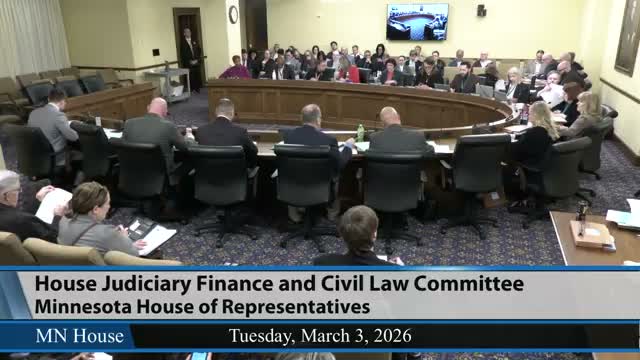
Summary
After testimony from civil-rights advocates and law-enforcement officials, the Judiciary, Finance and Civil Law Committee voted 7–6 against referring HF3661, a proposal to ban government use of facial recognition, after debate over privacy risks, bias, and public‑safety uses.
A Minnesota House committee on March 3 considered a proposal to ban government use of facial recognition but declined to advance the measure after a close roll-call vote.
Representative Feist presented House File 3661 on behalf of Rep. Gomez and moved an author’s A1 amendment, which the committee adopted. The bill would significantly restrict how government agencies may use facial recognition systems; Feist said the technology poses "serious privacy ramifications," comparing pervasive use to "wearing a blown up copy of your driver’s license on the outside of your shirt with a GPS tracking device attached." Feist said Minnesota currently has no statewide rules governing use, data sharing or retention.
Civil liberties experts urged a ban. Chad Marlow, senior policy counsel at the ACLU, told the committee the issue is nonpartisan and cited accuracy and bias problems. "Governmental use of facial recognition technology should not be permitted in Minnesota," Marlow said, arguing deployments had outpaced policymaking.
Privacy advocates echoed that view. Chris Whalen, chair of Restore the Fourth Minnesota, urged a ban or, at minimum, strict use policies and public disclosure, saying there is "no built‑in mechanism for individuals to opt out" and no statewide quality standards.
Law-enforcement officials pushed back. Major Spencer Baki of the Hennepin County Sheriff’s Office said his agency uses facial recognition only as an investigative lead — never as positive identification — and that the system is not linked to live camera feeds for ongoing surveillance. Baki said trained analysts corroborate any leads and described benefits in resolving human‑trafficking and homicide cases. He asked the committee to focus on statutory safeguards rather than an outright ban.
Members questioned agencies’ policies and data practices. Major Baki said the sheriff’s office retains suspect‑photo data while a case is active and purges stale records during an annual records audit; he said that in 2025 the office ran roughly 809 requests and generated about 335 investigative leads.
Representative Hudson and other members advocated a narrower, standards‑based approach that would govern admissibility and data handling, while others said the technology’s current use makes a strong case for restrictive action now.
After debate, Representative Hudson requested a roll-call. The recorded vote was 7 Aye, 6 Nay under committee rules; the motion to refer HF3661 to the Public Safety Finance and Policy Committee did not prevail and the bill did not advance from the committee.
The committee’s actions leave HF3661 available for reconsideration in future committee calendars; proponents said further stakeholder talks and statutory drafting could follow.