
MPCA presents 2026 Climate Action Framework; modeling shows current policy falls short of statutory goals
Get AI-powered insights, summaries, and transcripts
Subscribe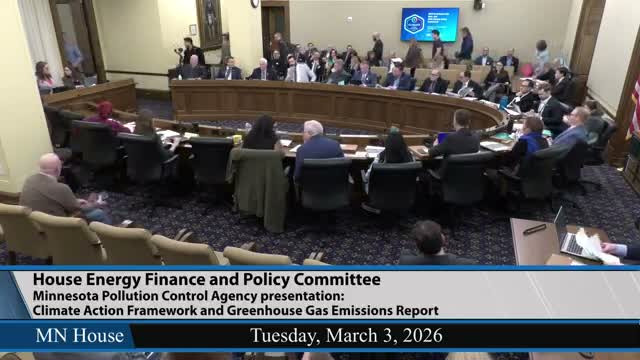
Summary
The Minnesota Pollution Control Agency presented updated greenhouse‑gas inventory data and the 2026 Climate Action Framework, forecasting current policy will deliver roughly 39% reductions by 2050 while a potential policy pathway could reach about 77%; MPCA also estimated $1.17–$2.28 billion in conservative air‑quality health benefits tied to emissions reductions.
The Minnesota Pollution Control Agency (MPCA) briefed the House Energy, Finance and Policy Committee on its updated greenhouse‑gas inventory through 2023 and released the 2026 Climate Action Framework, a multi‑agency document that pairs emissions forecasting with near‑term priorities and a menu of action steps.
MPCA Assistant Commissioner Frank Kolash opened the presentation by noting the work was developed with the governor’s Climate Change Subcabinet and the governor’s advisory council on climate change. Kate Knuth, MPCA climate director, summarized the updated inventory and the framework’s findings: she said Minnesota’s statewide greenhouse‑gas inventory fell from approximately 146,000,000 metric tons in 2005 to roughly 117,000,000 metric tons in 2023 — about a 20% reduction — and that the largest current emissions source is transportation, followed by agriculture and electricity generation.
Knuth described three model scenarios developed for the framework: a current‑policy scenario (which assumes implementation of existing law, including the 100% carbon‑free electricity by 2040 requirement), a potential‑policy pathway composed of a suite of stronger measures, and a net‑zero scenario that forces economy‑wide neutrality. She said the current‑policy trajectory is forecast to achieve about a 39% reduction by 2050, while the potential‑policy pathway could achieve roughly a 77% reduction. Knuth highlighted that the electricity sector has already seen major gains (about a 50% drop since 2005) and noted increases in emissions in some building and industrial sub‑sectors.
MPCA also presented quantified ancillary benefits of emissions reductions: a conservative estimate of air‑quality health benefits of $1.17 billion to $2.28 billion, as well as modeled reductions in premature deaths, asthma symptom days, lost workdays and missed school days tied to improved air quality.
Lawmakers asked for access to the technical materials and modeling documentation. MPCA said a 100‑page technical support (forecasting) document and several supplementary appendices are available and offered staff follow‑ups for legislators seeking deeper data or briefings. In oral Q&A committee members probed modeling assumptions, how the 2040 electricity law is incorporated (MPCA said it is built into the current‑policy scenario), whether the modeling could include nuclear options (MPCA deferred policy decisions on nuclear moratoria to the Department of Commerce and the legislature but said existing nuclear operation was assumed in the forecast), and how agriculture and natural/working lands are represented.
MPCA emphasized near‑term priorities in the framework — including solidifying implementation of 100% carbon‑free electricity by 2040, accelerating EV adoption, scaling climate‑smart heat solutions for buildings and industry, restoring peatlands and forests, strengthening resilience investments, and advancing financing strategies — while also calling for deeper local and tribal engagement and improved metrics for tracking progress. MPCA asked legislators to use the technical support materials to explore policy levers and to consider the framework’s scenarios as guideposts for where additional action could accelerate emissions reductions.
The committee paused after the presentation with plans for follow‑up briefings and more detailed access to the forecasting materials.