
Secretary of state’s administrative bill moves forward after debate on canvassing timelines and vouching amendments
Get AI-powered insights, summaries, and transcripts
Subscribe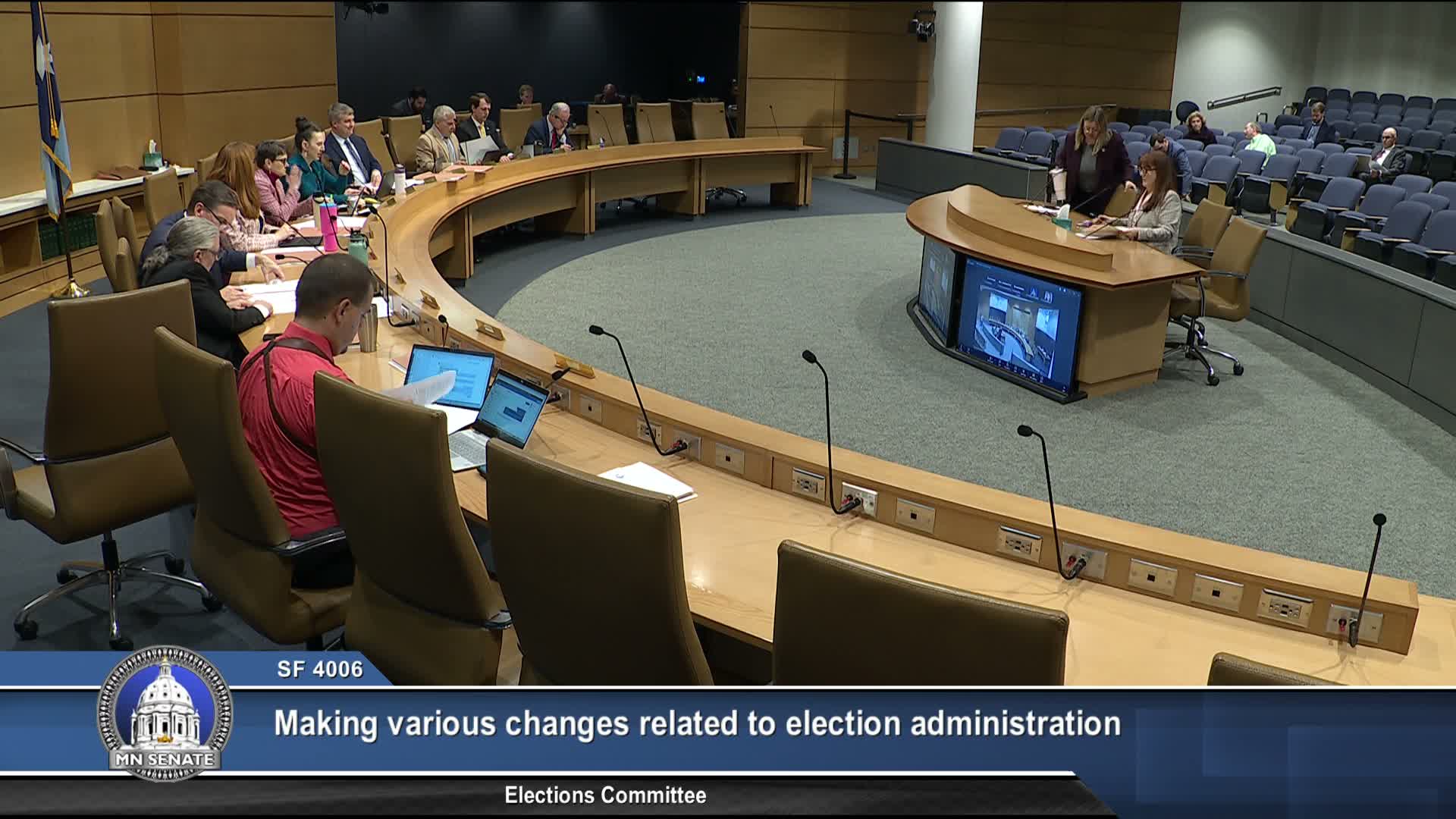
Summary
Senate File 4006, the secretary of state's administrative bill, would give local officials flexibility on absentee voting access, standardize use of the statewide voter registration system, and create reimbursement procedures for special elections; amendments to limit vouching and require physical addresses failed on roll calls, and the bill was laid over for possible omnibus inclusion.
Senate File 4006, carried by Senator Westlund, was presented March 3 as the secretary of state's administrative bill. The A5 author's amendment to format the bill passed, and Westlund and Secretary of State staff provided a section-by-section summary of the measure.
Major provisions described by the author and Secretary of State staff include: allowing cities that administer absentee voting to choose whether to be open for the full 46 days or only the last 18 days (intended to provide flexibility and cost savings); updating the agent-delivery qualification language to reference the statutory standard for the last seven days before an election; requiring statewide voter registration system use for processing absentee applications (except March township elections); clarifying early-voting recordkeeping and end-of-day procedures; creating a reimbursement process for local officials who administer state or federal special elections not held with the general election; and removing the statutory ability to license the state's voter-registration source code to other states for security reasons.
Ms. Freeman from the Secretary of State's office said the A5 includes timeline expansions for canvassing that cities and school districts requested so they can certify results at regularly scheduled meetings rather than calling special meetings. Committee members asked whether the canvassing-time change was about workload or scheduling; Freeman said the change is scheduling flexibility so local bodies can meet during their regular calendars.
Local-government representatives supported the canvassing change. Pierre Wolett of the League of Minnesota Cities told the committee the change provides convenience and cost savings by avoiding separate special meetings for canvassing.
Senator Lucero offered two notable amendments focused on election integrity: A4 would remove the vouching allowance (where one person can vouch for up to eight others) and replace it with provisional balloting; A3 would require a physical address to be eligible to vote (removing the option to provide a descriptive location). Committee debate on A4 and A3 centered on balancing election integrity concerns and access for homeless voters and tribal members without standard residential addresses. Both amendments were subject to roll-call votes and failed: A4 failed on a tie (5–5) and A3 failed 5–6. The record shows members voting both for and against on party and constituency grounds.
Senators and staff also discussed fiscal implications; staff indicated a fiscal note request is outstanding and that Section 9 creates an open appropriation for reimbursements but the likely cost is uncertain. Several members asked for follow-up materials: counts of returned non-deliverable same-day registration mailers and data on how often registrants used descriptive-location options instead of physical addresses.
Senator Westlund closed by saying SF 4006 would be laid over for possible inclusion in an omnibus bill; no final passage occurred at this hearing.
Next steps for the committee include reviewing the outstanding fiscal estimate, receiving follow-up data from the Secretary of State's office, and potential inclusion of the bill in the omnibus process.