Get Full Government Meeting Transcripts, Videos, & Alerts Forever!
Get email alerts on the Udo Amendment topic
No spam. Unsubscribe anytime.
Planning staff outlines broad UDO amendments, plans consultant search
Summary
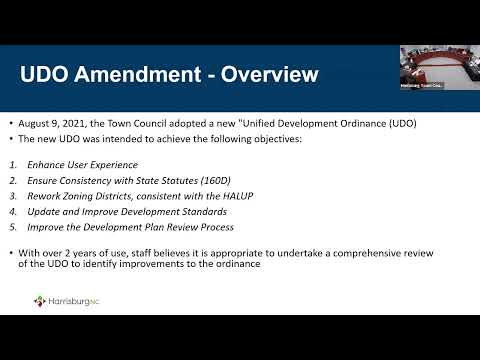
Town planning staff told the Planning and Zoning Board that a comprehensive update to the town's Unified Development Ordinance (UDO) will focus on user experience, statutory compliance (160D), and higher development standards; staff proposed hiring a consultant and holding workshops beginning this spring.
Presenter told the Town of Harrisburg Planning and Zoning Board on Feb. 20 that staff will pursue a comprehensive update of the Unified Development Ordinance (UDO) to improve usability, resolve inconsistencies, and ensure compliance with state law.
The presentation identified four principal goals: improve the user experience of the online ordinance, correct internal inconsistencies and broken links, align ordinance language with North Carolina statute 160D, and raise standards for development quality — including building design, tree preservation and sustainability. "We want this to be intuitive," the Presenter said. "You should be able to pull up our parking requirements very quickly, find out our standards and run with it." The Presenter also noted a new building-design requirement for larger residential buildings: "any building, some residential over 4,000 square feet, there has to be a second story," and said that requirement was intended to control building massing and streetscape character.
Staff said the current UDO has produced a mix of outcomes since its adoption in 2021 and that repeated amendments (for signage, food trucks, vape shops and temporary uses) have revealed interdependencies that are best addressed through a holistic review. The Presenter pointed to several operational problems already identified: links in the online UDO that still reference the older code, inconsistent cross-references, and sections that lack necessary detail or, conversely, include excessive technical content that confuses users.
The presentation also warned of legal exposure if the town adopts requirements beyond its statutory authority. Referencing North Carolina's statutory framework (160D), the Presenter cited a prior litigation example in Davidson in which a town faced a costly judgment after imposing a developer charge the court later found beyond local authority. "We have to be careful because in North Carolina the legislature has narrowly defined what we can do," the Presenter said.
As a next step, staff said it will draft a scope of services and solicit a planning consultant to work with the town on a comprehensive UDO review. The Presenter said the consultant selection process is expected to run in the spring, with consultant work and topic workshops roughly in the March-through-May window. Staff said the outreach plan will include an umbrella presentation followed by topic-specific work sessions and public review, and that some fixes will be prioritized as short-, medium- and long-term items. "We're not going to stop development while we make repairs," the Presenter said. "This will be an ongoing process."
The board did not take formal action on the UDO update at the meeting; staff will return with scope documents and a timeline for consultant selection and the public engagement process.