
Report: Strong upwelling and abundant forage in 2025, but offshore marine heatwave and harmful algal blooms raise concern
Get AI-powered insights, summaries, and transcripts
Subscribe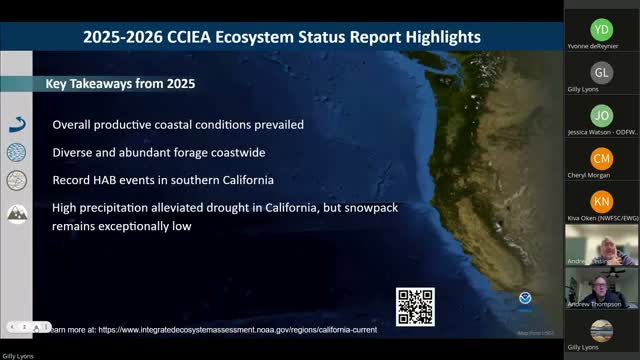
Summary
The Fishery Management Council, Pacific heard a 2025 Ecosystem Status Report finding strong, early upwelling and abundant forage that supported seabirds and some fisheries, alongside record offshore marine heatwaves, widespread domoic acid events and lingering risks from low snowpack and port processor closures.
The Fishery Management Council, Pacific was briefed on the 2025 Ecosystem Status Report, which found that strong, early upwelling produced productive coastal conditions and abundant forage across much of the West Coast even as the region experienced record offshore marine heat and major harmful algal blooms.
The report’s presenters said 2025 produced “very diverse and abundant forage” — including anchovy, young-of-year rockfish, juvenile Chinook and krill — that helped seabird reproductive success and buoyed some predator diets. “We saw an increase in total fishery landings in 2025, up 26% from 2024,” Amanda Phillips of the Northwest Fisheries Science Center said, attributing the boost largely to Pacific whiting and market squid catches.
Why it matters: favorable upwelling and abundant forage can improve short-term survival for many predators and fisheries, but the team flagged several risks that could reverse gains. Andy, the physical‑oceanography presenter, said the Northeast Pacific experienced “the largest marine heat wave on record” in the region’s data (since 1982), and the team connected an anomalous early upwelling event to a subsequent major domoic acid harmful algal bloom that affected marine mammals, shellfish and human health.
Supporting details: presenters described a year of strong spring and summer upwelling that increased chlorophyll and forage availability, while also producing one of the largest low bottom‑oxygen footprints observed in June in the JASO survey time series. Mary Hunsicker summarized ecosystem survey results showing rockfish pulses in multiple regions and record pyrosome abundance in the Central California Current; seabird fledgling production increased at most colonies monitored in 2025.
Outlook and caveats: model forecasts presented to the Council project ENSO moving from La Niña toward neutral and possibly into El Niño later in the year. The presenters warned that snowpack remained extremely low across much of the West, raising concern for warmer stream temperatures that could harm salmon outmigration. The team also noted that forecast models can miss atypical “oddball” events and said they will continue close monitoring into spring and summer 2026.
Next steps: the report includes appendices and a planned interactive dashboard to let managers and advisory bodies examine distribution shifts and indicators across species; the team expects more detailed short‑term forecasts in 2026 to refine the outlook for fisheries and ecological responses.