Get Full Government Meeting Transcripts, Videos, & Alerts Forever!
Get email alerts on the Veterinary Ipc topic
No spam. Unsubscribe anytime.
New York City releases FirstLine module for veterinary infection prevention, highlights gaps in veterinary IPC
Summary
The New York City Health Department introduced a free FirstLine digital module to simplify veterinary infection‑prevention and control guidance, citing retrospective lab findings of carbapenem‑resistant organisms and persistent IPC gaps in veterinary practice.
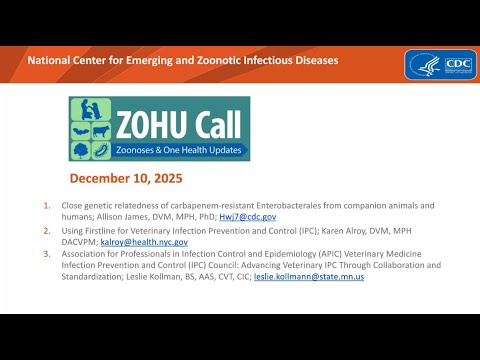
Dr. Karen Alroy of the New York City Health Department described rising carbapenemase‑producing Enterobacterales (CRE) detected through NYC electronic laboratory reporting and presented a veterinary IPC initiative that adapts CDC and human‑health tools for veterinary settings.
Alroy said the city analyzed antimicrobial‑susceptibility data from a large commercial veterinary diagnostic laboratory and identified 256 gram‑negative carbapenem‑resistant organisms submitted by New York City veterinarians during 2019–2022; because these were retrospective data, public‑health follow‑up with facilities was not possible. She reviewed literature showing veterinary outbreaks where IPC gaps (for example, failures in endotracheal tube reprocessing or diluted disinfectant) contributed to spread, and she cited surveys that found low hand‑hygiene compliance in veterinary settings.
To address gaps, the NYC Health Department compiled veterinary‑focused IPC resources into a free module on the FirstLine clinical decision‑support platform. The FirstLine veterinary content includes: bite‑sized IPC principles adapted for veterinary workflows; the "5 moments" for hand hygiene tailored to animal care; disease‑specific guidance for diagnosis, transmission, PPE, cleaning and disinfection; downloadable posters; and jurisdictional reporting links—with NYC‑specific reporting pathways noted for in‑jurisdiction users.
Alroy emphasized that FirstLine content is a starting point and should be adapted to facility‑specific policies and individual health considerations (for example, pregnancy or immunocompromise). She encouraged collaborations with local and state health departments, academic institutions and professional organizations to support IPC improvements, and highlighted that some IPC improvements require monetary resources while other elements can be strengthened through training, mentorship and partnerships.
The presentation pointed attendees to free posters, videos and downloadable tools available through the app and to NYC reporting resources for companion‑animal diseases. The FirstLine veterinary module was described as live and freely available to download or access via web browser.