Get Full Government Meeting Transcripts, Videos, & Alerts Forever!
Get email alerts on the Antimicrobial Resistance topic
No spam. Unsubscribe anytime.
CDC analysis finds genetically close carbapenemase-producing Enterobacterales in companion animals and humans
Summary
A CDC One Health team reported genomic evidence that carbapenemase-producing Enterobacterales (CPCRE) recovered from U.S. companion animals and people cluster closely, suggesting possible regional sharing of high‑risk strains and underscoring the need for more veterinary surveillance and infection prevention.
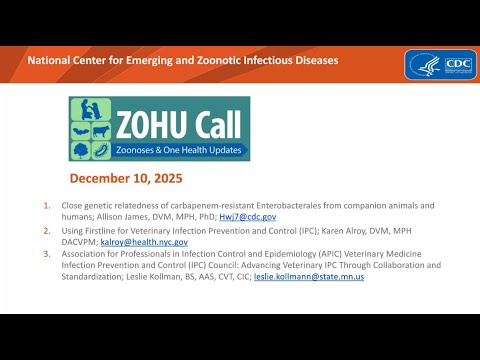
Allison James, who leads the One Health Antimicrobial Resistance Program at CDC, presented a genomic analysis showing that carbapenemase-producing Enterobacterales (CPCRE) collected from dogs and cats in the United States are often genetically close to isolates from humans. James said researchers queried the NCBI Pathogen Detection Database, filtered for U.S. dog and cat isolates that clustered with human isolates, and after data cleaning retained 11 One Health clusters comprising 562 isolates for comparative analysis.
James said the dataset included 169 companion‑animal isolates (155 dogs, 14 cats) and 393 human isolates across three bacterial species, with most isolates being Escherichia coli. All clusters contained NDM‑family carbapenemase genes; nine clusters included isolates with NDM‑5 and two contained NDM‑7. Phylogenetic trees showed animal and human isolates interspersed within the same clusters, and allele‑range comparisons indicated that animal–human pairs were at least as closely related as human–human pairs in many cases.
"These results show that zoonotic transmission of multiple CPCRE pathotypes is possible and already occurring in the U.S., either through direct transmission or a common environmental source," James said. She added that in seven of the 11 clusters, closely related human–animal pairs were collected from the same geographic region, which the team interpreted as evidence of region‑specific substrains already circulating.
James cautioned that the study used publicly available sequence data and is a convenience sample, which could introduce sampling bias, particularly for geographic clustering. She noted the analysis did not establish transmission directionality and that only a small number of previously reported human–animal transmission events exist in the literature.
Based on the findings, James recommended expanded genomic surveillance that includes companion animals, enhanced infection prevention and control in veterinary settings (especially veterinary hospitals), and systematic research to quantify prevalence, incidence, and risk factors for CPCRE in animals.
The presentation described the use of CG‑MLST for phylogenetic comparisons and cited the NCBI Pathogen Detection Database as the data source. James also said CDC piloted CPCRE testing of companion animal specimens within its Antimicrobial Resistance Laboratory Network and is collaborating with public‑health, academic and clinical partners to support veterinary awareness and prevention materials.
The webinar discussion included questions about environmental or wildlife surveillance for CPCRE; James said she was unaware of established routine surveillance in wildlife but noted occasional studies and referenced earlier joint projects involving EPA, FDA and CDC whose current status she could not confirm.
Next procedural steps noted by presenters included promoting expanded sampling and surveillance and developing veterinary‑focused IPC resources; no formal actions or votes were recorded.