Get Full Government Meeting Transcripts, Videos, & Alerts Forever!
Get email alerts on the Emergency Medical Services topic
No spam. Unsubscribe anytime.
Rio Rancho Fire Rescue adds on-scene plasma, advanced airway tools and plans two station projects
Summary
Deputy Chief Jake Bailey told the mayor and council that the department has added liquid plasma, emergency chest decompression and medication-facilitated airway management to its field care toolbox and outlined timelines for Fire Station 8 and a Station 3 apparatus-bay addition.
Deputy Chief Jake Bailey told the Rio Rancho mayor and governing body that Rio Rancho Fire Rescue has added three hospital-level interventions to its field care capabilities and is advancing two station projects aimed at improving response coverage.
"These are all special skills," Bailey said, describing liquid plasma administration, finger thoracostomy (emergency chest decompression) and medication-facilitated airway management (MFAM). He said the skills are not normally within New Mexico paramedics' scope and credited the department's medical director and EMS division for the training and approvals.
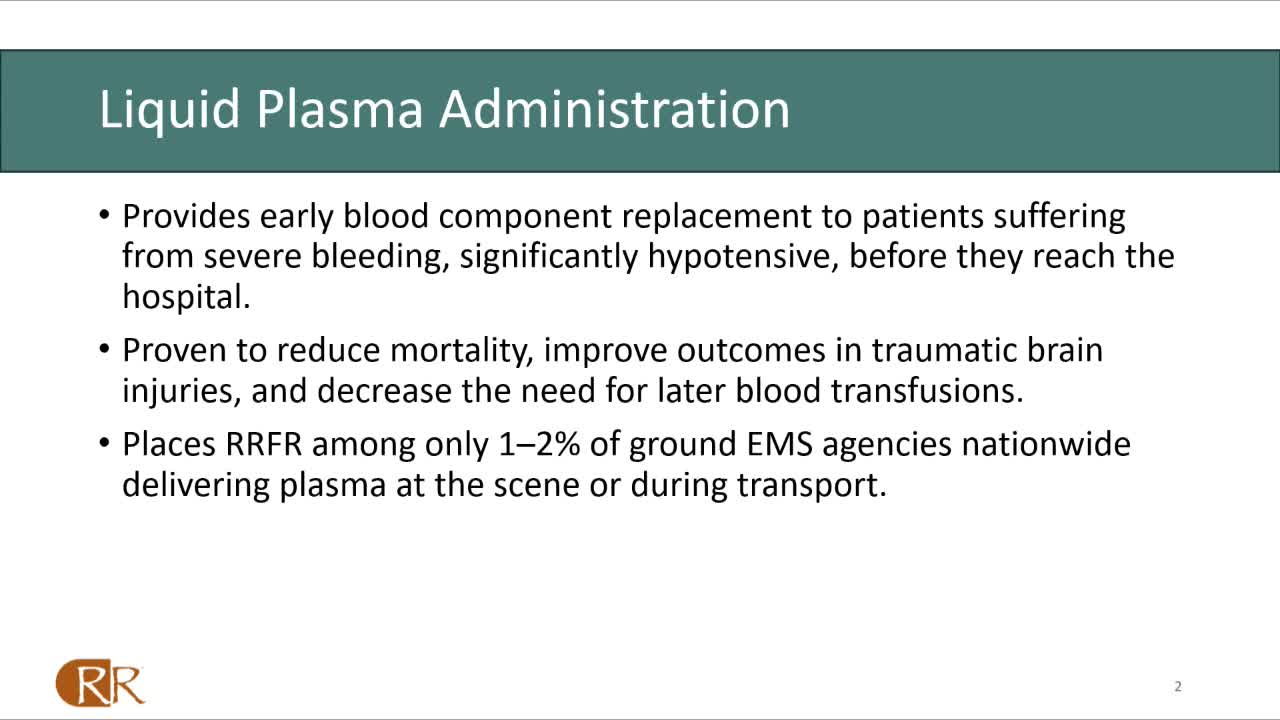
Bailey said liquid plasma — a blood product used in the field for patients with severe bleeding or significant hypotension — gives crews an oxygen-carrying fluid that can dramatically improve outcomes before hospital arrival. He added that deploying plasma in ambulances places Rio Rancho among the roughly 1–2% of ground ambulance services nationally that can deliver plasma on scene.
On trauma care, Bailey said finger thoracostomy allows paramedics to rapidly relieve life-threatening pressure in the chest after severe trauma, restoring lung function earlier than waiting for a hospital procedure. He described MFAM as a way for specially trained paramedics to secure airways with medications in chaotic scenes.
The presentation also included capital-project updates. Bailey said bids for Fire Station 8 close March 26, with the contract expected to be awarded at the April 9 council meeting and a groundbreaking planned for mid-to-late April; he estimated construction will take about 12 to 18 months. He described Station 8 as a large, modern facility that will reduce response times and include an election space.
Bailey said an apparatus-bay addition at Station 3 is next in the pipeline, with design and construction costs estimated at about $1,000,000. The addition would allow the station to house another apparatus, protect HDR equipment currently stored outdoors and potentially enable specialty positions such as a wildland coordinator.
Councilors thanked Bailey and the Fire Rescue staff. Councilor Colbert said, "I just wanna say thank you so much to you and your team. I think this is so impressive." Other council members emphasized that a majority of calls are medical in nature and praised the department's paramedicine work.
The city manager added personnel context, thanking Bailey and noting Bailey will be leaving in early summer; the manager said city-supported training programs have steadily increased paramedic staffing and that the city expects roughly 40 paramedics once the upcoming graduating class finishes in May.
The work session contained no action items; the council received the report and asked no formal questions that required immediate direction or a vote.