
Green Tree residents press PennDOT on I-376 realignment over safety, noise and pedestrian protection
Get AI-powered insights, summaries, and transcripts
Sign Up Free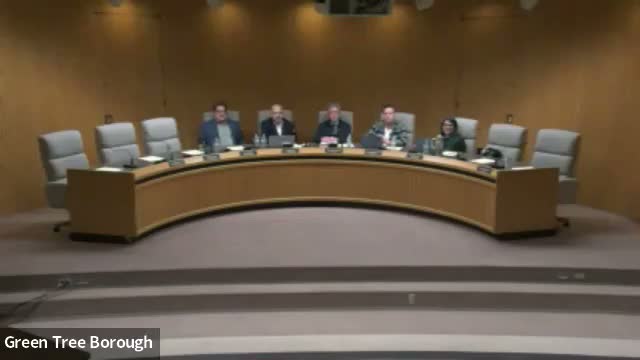
Summary
Residents and councilors at a Green Tree workshop urged PennDOT to change aspects of a proposed I-376 realignment, raising concerns about a Poplar Street ramp, the removal of a concrete pedestrian barrier on the Green Tree Road bridge, and where sound-wall noise might be displaced.
Residents and borough officials pressed for design changes to PennDOT's proposed realignment of Interstate 376 during Green Tree's Feb. 16 workshop, flagging potential traffic, pedestrian-safety and noise impacts to nearby neighborhoods.
The borough mayor (S1) summarized PennDOT's written response to a borough letter, saying PennDOT analyzed two options for the Poplar Street off-ramp: restrict right turns from the ramp or remove the ramp entirely. "Borough council was not in favor of completely eliminating the Poplar Street ramp," the mayor said, and the borough supported an option that would restrict right turns instead. He added, however, that PennDOT told the borough certain design choices will require police enforcement and that the agency retained decision authority.
Residents described how the proposed loop ramps and reconfigured turns create new conflict points. "These loops are about as poorly designed as you could imagine," said Jesse Robinson Evans (S3), who cited crash data and urged geometric changes to force safer turning movements. Aldo Art Pilati (S7) warned that converting the Butler Street ramp to an exit could push truck and shortcut traffic onto local streets and said existing weight limits on parts of Poplar Street should be part of PennDOT's analysis.
Pedestrian protection on the bridge over the parkway was another flash point. The mayor said PennDOT removed the existing concrete barrier between the sidewalk and roadway because current safety protocols and sight-line requirements made the old barrier unsafe for the new design. "They can't do the barriers as they are today because of the updated safety protocols," the mayor said, and added PennDOT plans to rethink the bridge with wider sidewalks and wider shoulders to move vehicles further from pedestrians.
Several residents opposed removing a physical barrier. "A concrete barrier would stop a vehicle where a fence would not," a resident (S3) said, urging bollards or a continuous physical barrier. Councilors and residents debated whether a single-sided sidewalk with crossing points or sidewalks on both sides would better balance pedestrian comfort and safety.
Noise mitigation also remains unresolved. The mayor said PennDOT has not completed right-of-way determinations or a final noise study, and that the final height and extent of any sound wall could change when the noise study is complete. Residents warned that a sound wall can displace noise, sending it into adjacent neighborhoods; councilors asked PennDOT to clarify how impacts would be distributed.
The mayor noted PennDOT also requested the borough not publicly release some documents the agency provided, saying the documents belong to PennDOT and that the agency intends to present its findings at a public meeting scheduled for 2026.
What happens next: councilors said they will continue to gather resident feedback and relay concerns to PennDOT and other public officials. The borough's role, they emphasized, is advocacy and conveying community priorities during the design phase; PennDOT retains final design authority.