
Kalamazoo City presents economic development update, cites $278 million in recent investments and expanded equity programs
Get AI-powered insights, summaries, and transcripts
Subscribe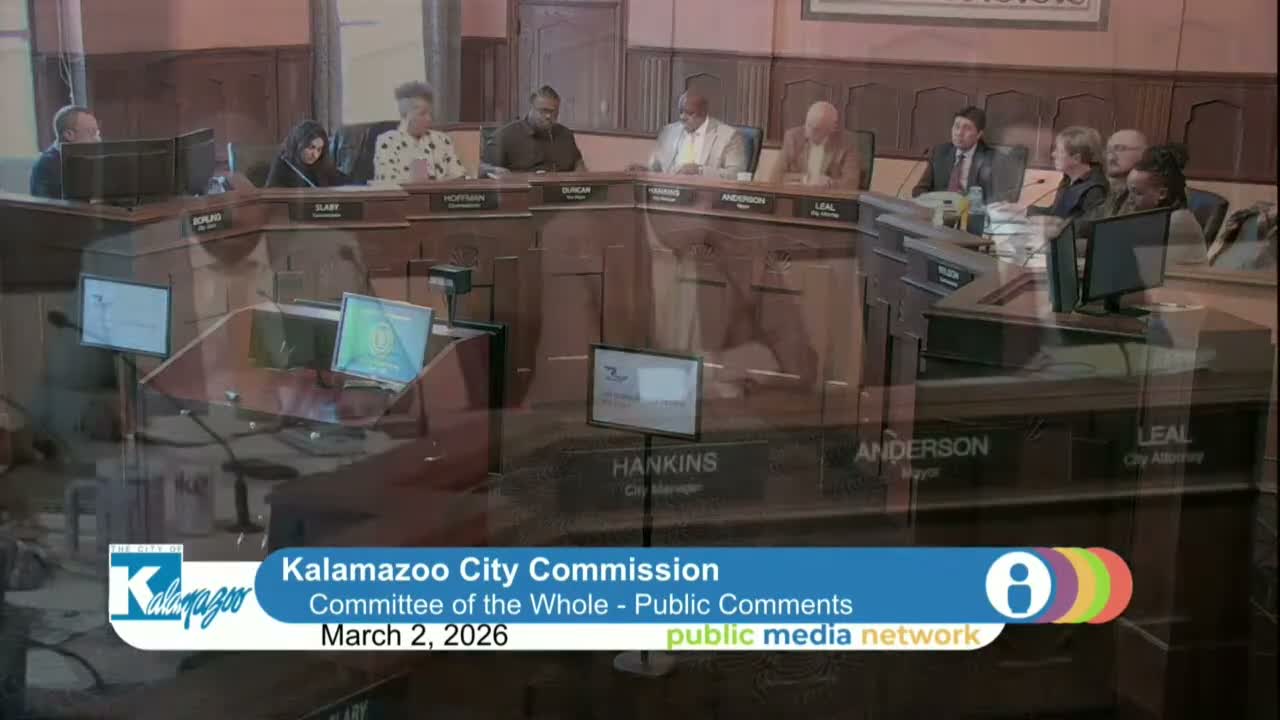
Summary
City staff told the Committee of the Whole that the economic development division helped attract roughly $278 million in investment in 2025, expanded microenterprise grants and launched a citywide PR/branding campaign; the city’s cannabis social equity chamber reported workforce and grant outcomes reaching intended neighborhoods.
At a Committee of the Whole meeting, city economic development staff presented a strategy update that officials said helped leverage about $278,000,000 in private and capital investment in 2025 and expanded small-business supports, including microenterprise grants and a new PR and business-attraction campaign.
Manager Hankins opened the presentation and introduced Bobby Boyd, the city’s economic development supervisor, who reviewed four strategic pillars — fostering the business environment, strengthening neighborhoods and community connections, improving the downtown experience, and advancing conditions for growth — and outlined 2025 accomplishments. Boyd said the division streamlined permit processes for certain marijuana renewals and liquor licenses, expanded ribbon cuttings, and increased grant and capital activity tied to business support.
"We've helped advance investments within the city of Kalamazoo up to $278,000,000," Boyd said, listing capital and grants the division said supported development in 2025. He also described several business-support programs, including EIF gap financing intended as last-source capital (described in the presentation as up to 10% of a capital stack or a $250,000 cap) and the Kalamazoo microenterprise grant (KMEG) that provides $5,000 awards to qualifying microbusinesses.
The presentation highlighted a newly soft-launched ecommerce platform, Shop Local Greater Kalamazoo, built with the local Chamber to help storefront and home-based businesses sell online and to filter listings by business type, ownership and active construction zones. Boyd said the tool is one of several ways the city will attempt to sustain businesses during prolonged corridor construction, paired with proactive communications and a business-retention directory.
Boyd also outlined downtown-focused work — a unified downtown brand, an expanded ambassador program with a three-year contract, and the city hosting the Michigan Downtown Association conference — and said staff supported a $103,000,000 bond through the economic development corporation board for a Friendship Village senior housing expansion on the west side.
Rebecca Collette, who leads the city’s cannabis social equity chamber, delivered a separate presentation on the chamber’s two-year implementation role. She said the chamber has hosted more than 60 workforce education events and engaged over 2,000 participants, helped enroll about 70 residents in Kalamazoo Valley Community College cannabis certificate programs (61 certificates completed) and reported participant demographics she described as roughly 70% women, 60% BIPOC and 65% from the city’s SPK neighborhoods.
"This work exists to close that gap, not just through licensing, but through workforce access, education, and economic mobility," Collette said, describing the chamber’s roughly $300,000 annual budget and citing scholarship and community-directed giving the chamber reported in its operations.
Commissioners asked detailed follow-up questions. Commissioner Wilson and others pressed whether city programs reach prospective entrepreneurs who have not yet formed businesses; Boyd said the city partners with existing entrepreneurship organizations rather than duplicating services and that it provides funding to partners who offer start-up assistance. On EIF loans, Boyd said the program is designed as gap financing to finalize capital stacks rather than to be the primary startup loan.
Commissioner Hoffman raised equity concerns for the North Side, noting many storefronts and liquor outlets and asking what the city can do to increase ownership and local economic benefit. Staff said they changed local square-footage requirements to close a loophole that had allowed some small-format stores to qualify as "grocery" and thereby circumvent distance limits on liquor licenses; the city will consult the city attorney about possible further changes to distance or zoning rules.
Staff also previewed a KMEG 2 program that would increase awards for prior recipients from $5,000 to $10,000 to help businesses scale, and described partnerships with Western Michigan University, Discover Kalamazoo and other local vendors and nonprofits to support PR, data analysis and local contracting.
Public comment included a Kalamazoo resident, Edward Nickerson, who said a person claiming to be parking enforcement confronted him and that the city’s parking enforcement practices make it difficult for people with disabilities to comply. "Parking enforcement's made it impossible for me to figure out how to pay for parking due to my disability," Nickerson said.
Before adjourning, the commission approved a motion to go into a closed session to discuss an attorney–client privileged communication; the roll-call vote was recorded as in the affirmative and the Committee of the Whole adjourned without returning to open session. The presentation materials and staff follow-ups — including additional detail on EIF loan criteria, the potential restoration of facade/white-box improvement grants, precise KMEG 2025 award counts and exact dates for the Michigan Downtown Association conference — were left for future meetings or staff follow-up.
Next steps: staff said they will circulate more detailed program documentation, coordinate with the city attorney on licensing/zoning questions raised by commissioners, and continue implementation of the PR campaign and KMEG 2 planning.