Get Full Government Meeting Transcripts, Videos, & Alerts Forever!
Get email alerts on the Budget 2026 topic
No spam. Unsubscribe anytime.
Clallam County unveils proposed 2026 budget; public hearing continued amid dispute over opioid‑settlement funding
Summary
County finance staff presented a $57.3 million general‑fund budget for 2026 with a $1.2 million projected deficit after adjustments; public testimony focused on a planned $50,000 opioid‑settlement allocation for harm‑reduction services and the hearing was continued to 5 p.m. for follow‑up.
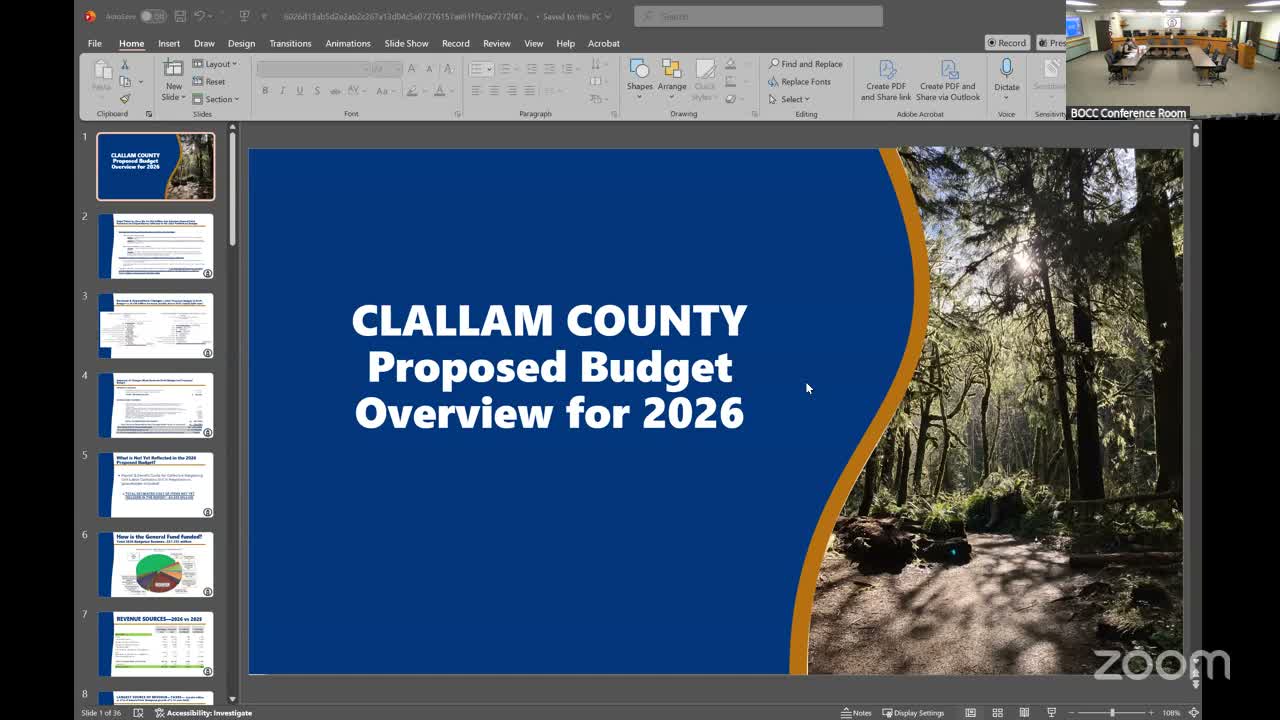
County finance staff presented a proposed 2026 budget on Dec. 2, 2025 that would set general‑fund revenues at roughly $57.3 million and leave a projected operating deficit of about $1.2 million after one‑time and recurring adjustments. The Board of Commissioners opened a noticed public hearing on the budget and continued it to 5 p.m. for more discussion and revised schedules.
The county’s finance presenter summarized the work that narrowed an initial $3.3 million gap, saying the office identified approximately $4.28 million in revenue gains and expenditure reductions, including about $1.6 million of new recurring revenue and roughly $1.4 million of recurring expenditure reductions. The presentation noted one‑time gains—an advance from an HCA Medicaid reentry grant and other carryovers—helped close the near‑term shortfall and that the county’s projected ending reserves would be about $14.8 million, or 25.2% of planned expenditures.
“Based on the proposed budget, we expect reserves to finish the year at 25.2%, which is in line with our 25% goal,” the presenter said during the slide presentation. Staff also explained that timing of grant spending—particularly an advanced $4 million HCA reentry grant received in 2024—creates year‑to‑year volatility in the county’s grant revenues.
Public commenters focused much of their testimony on a separate but related funding decision: the county’s planned use of opioid‑settlement dollars for harm‑reduction services. Several members of the public urged the commission to reconsider the allocation. “Harm reduction is failing us,” said James Seager, who identified himself as a District 3 resident; he urged funds be used for treatment, housing or assessment capacity rather than what he described as enabling open drug use. Mark Curtis of Sequim said the county should prioritize detox services and criticized the ecological impacts of discarded supplies. Jeff Tozer told the board volunteers had recently collected hundreds of needles from a local creek and asked for measurable outcomes tied to any syringe distribution program.
Commissioners, while acknowledging public concerns, defended the county’s broader approach. The Chair recalled a recent work session and said harm reduction is one of several strategies the county uses, including criminal‑justice enforcement partnerships, jail treatment programs and housing and workforce efforts. “The evidence shows that people that engage in harm reduction are more likely to engage in services,” the Chair said, adding that preventing fatal overdoses is a principal goal.
Staff also proposed several technical, non‑general‑fund adjustments to be incorporated into the budget—carryovers of LTAC (lodging tax) awards that affect roads and lodging funds, and an accounting correction moving $74,081 in HHS costs to the opioid settlement fund to reflect funding sources correctly. Commissioners directed staff to prepare revised schedules and documents for the continuation of the hearing.
Votes at a glance - Consent agenda (multiple reappointments, calls for hearings, allocations including item 1Q): approved by voice vote; outcome recorded as approved. - Memorandum of Understanding Amendment (recompete coalition): approved unanimously. - Agreement with Department of Ecology for Clean Water PIC: approved unanimously. - Agreements with Jefferson County for North Pacific Coast Marine Resources Committee and several Title 3 grants to fire districts and search & rescue: each approved by voice vote. - Developmental‑disability program agreements (Pierce Jones; Monica Meyer Consulting; First Step Family Support Center; Concerned Citizens): approved; contract amounts and terms read into the record. - Resolution establishing 2026 levy carve‑outs (veterans relief, land assessment, developmental disabilities): approved; staff read RCW citations and new per‑$1,000 levy rates on the record.
What happens next The hearing was continued to 5 p.m. the same day to allow staff to circulate revised schedules reflecting the identified non‑general‑fund adjustments and to answer outstanding questions about reserves, LTAC carryovers, FTE counts and accounting entries tied to the opioid settlement fund. Commissioners said they expect to consider final adoption at the continuation.
Reporting note: quotes and attributions in this article come from recorded public testimony and county staff presentations at the Dec. 2 hearing; all named speakers and functional labels match the meeting record.