Get Full Government Meeting Transcripts, Videos, & Alerts Forever!
Get email alerts on the Budget topic
No spam. Unsubscribe anytime.
City manager proposes balanced FY2026 budget, recommends voter‑approved tax rate to close $1.3M gap
Summary
Mount Pleasant staff presented a proposed FY2026 budget that would close an estimated $1.3 million shortfall by using the voter‑approved property‑tax rate, while keeping reserves near policy targets and deferring some capital decisions to a utilities master plan.
The Mount Pleasant City Manager presented a proposed FY2026 budget at a council workshop, urging the council to adopt the voter‑approved property‑tax rate to close an approximately $1.3 million operating gap and preserve reserve targets.
The manager said the budget is a 12‑month spending plan beginning Oct. 1 and emphasized that it is amendable after adoption. "The budget is a spending for the next 12 months starting October 1," he told the council, framing the document as a guide for city priorities and noting departments prepared their requests over the prior months. Finance staff showed the proposed budget totals ($15.08 million in operating and capital presentation figures) and said a proposed surplus would lift the general fund balance toward the council policy target of 20–25 percent.
Why it matters: Council members and staff flagged two tradeoffs: levying at the voter‑approved rate would raise revenue and protect core services, but it will be presented to residents as a tax increase. Staff said much of the added property‑tax revenue is earmarked for debt service; other increases are intended to rebuild reserves and to fund one‑time capital needs. The manager said the utilities fund also needs dedicated capital replacement dollars to address aging infrastructure.
Details: Staff presented three revenue options, including a 'no new revenue' calculation and the voter‑approved maximum. The manager recommended adopting the voter‑approved rate "to get ourselves a handle around this" and to avoid a structural deficit, while reiterating the council can amend the budget in future months. Finance staff told the council they consolidated several line items (notably IT/data‑processing costs) into centralized accounts to improve transparency and to capture savings.
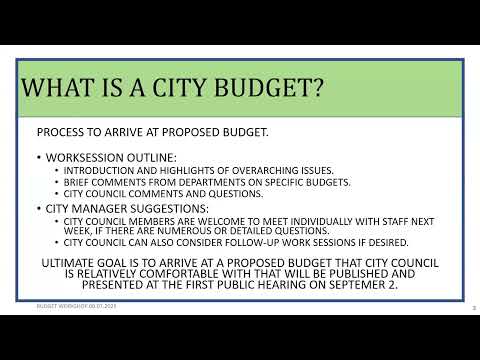
Council next steps: Staff asked members to submit any follow‑up questions and suggested a second work session if the council desires deeper review before the formal public notice and the scheduled public hearing. No formal votes were taken during the workshop; the presentation concluded with departments scheduled to present line‑by‑line detail during the remainder of the session.