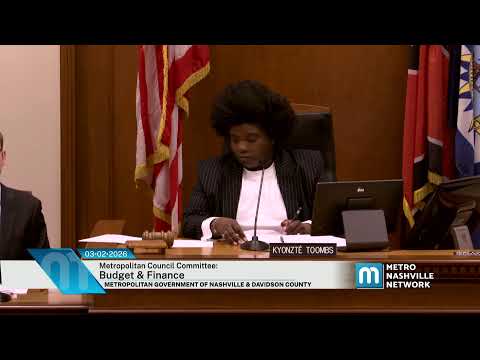
Council committee approves $28 across-the-board water credit after debate over fairness
Get AI-powered insights, summaries, and transcripts
SubscribeSummary
After a lengthy debate about fairness and fiscal impact, the council committee approved a one-time $28 credit to water and sewer customers tied to the June 2026 ice storm; Metro Water said state law requires the credit be applied uniformly, and the measure carries an estimated $6 million fiscal note.
A Metropolitan council committee voted to approve a one-time $28 credit to water and sewer customers after the June 2026 ice storm, despite objections from several members who said the credit would benefit many customers who were not financially affected.
The bill approving the credit was the subject of extended questioning by councilmembers about who would benefit and the fiscal impact. Metro Water staff told the committee the credit would produce a $6,000,000 fiscal-note estimate and that the utility’s internal estimate of the cost to produce the water is lower (roughly $4,000,000). Metro Water representatives said Tennessee billing statutes require uniform billing treatment, so the proposed relief must be applied across the board rather than targeted to only those customers with higher usage during the event.
"There's a very particular statute that says we have to bill and we have to collect a certain way," Metro Water representative Tara Ladd said, explaining why an individual review approach would be inconsistent with state law. Assistant Director Shannon Fry and Assistant Director John Hunnyside described existing, separate mechanisms under the code for customers who experienced a documented leak; those leak-related credits remain available through Metro Water's standard process.
Councilwoman Johnston argued that a broad $28 credit would allocate funds to customers who saw no increase in usage: "If this passes, every single customer is gonna get basically a $28 credit when 74% of customers did not have an impact at all," she said, and moved to defer the item one meeting to explore alternatives. Administration representative Rosenberg and Metro Water staff said a short deferral would delay relief but would not change the statutory constraint that led them to propose a uniform credit.
The motion to defer failed on a counted vote (3 in favor, 5 against, 2 abstaining). The committee then moved to final approval; the motion carried (final roll-call tally not recorded in the transcript). Metro Water said it is working with a consultant to determine implementation timing and logistics.
Why this matters: The measure distributes modest, immediate relief but raises questions about targeting scarce resources. Councilmembers who opposed the across-the-board approach urged staff to explore ways to direct aid to those most affected, while other members and administrators said the statutory framework limited available options.
What happens next: Metro Water will work with its consultant on an implementation timeline and the billing mechanics that will carry the credit to customer accounts. Customers with documented leaks or significantly higher usage can pursue separate, codified credits through Metro Water’s existing review process.