
Walton County considers turf vs additional ballfields as youth registrations swell
Get AI-powered insights, summaries, and transcripts
Subscribe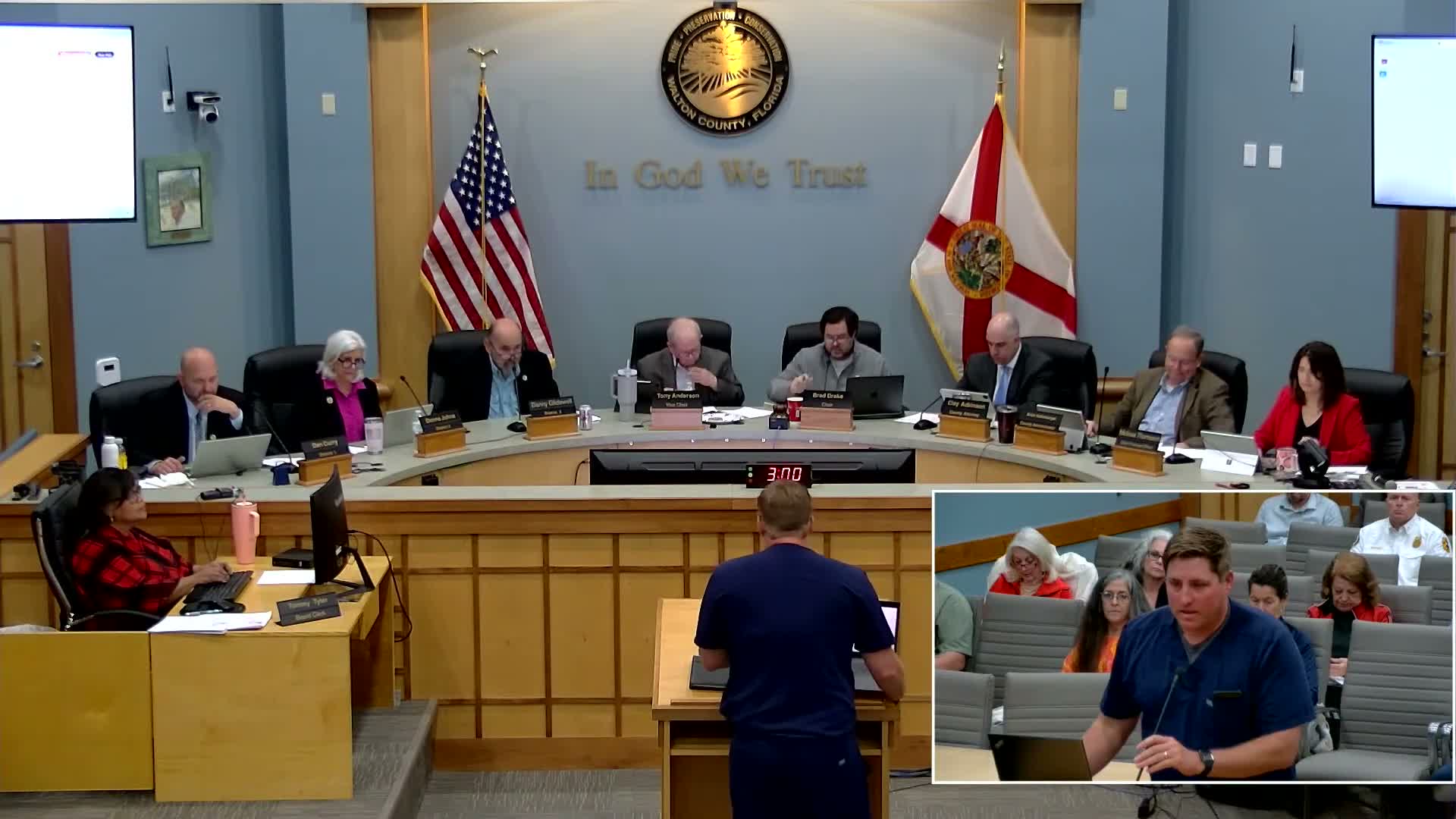
Summary
South Walton Little League reported record registrations — "over 520 kids" and 52 teams — prompting commissioners to weigh artificial turf (costs estimated $750,000–$1,000,000 per field) against building more natural fields; board directed staff to prepare a white-paper assessment and cost comparison.
Joel Duncan, volunteer president of South Walton Little League, told the Board that registration for the 2026 season topped "over 520 kids," producing 52 teams and creating a scheduling bottleneck with only three usable fields. He said the league needs room to play 12 required games for older divisions and that, as currently configured, the county cannot guarantee one game and one practice per team each week. (Joel Duncan)
Commissioners and public commenters debated possible responses. Several residents and commissioners raised concerns about the cost and safety of artificial turf — one commissioner said turf can become "extremely hot" and argued it could be "dangerous for young kids," while supporters noted that turf reduces rainouts and can be multipurpose. Cost estimates cited in the discussion ranged from $750,000 to $1,000,000 per turf field. (Commissioner Anderson; public commenters)
Rather than immediately spending funds on an outside feasibility study, the board directed county staff (Brad Alford, Shane Supple and others) to prepare a short white paper that compares initial installation costs, maintenance and equipment needs, likely usage policies, and options such as a pilot turf field versus building additional natural fields at the North End. Commissioners also suggested comparing the cost of turfing a group of fields to adding five or six natural fields on newly acquired land.
Why it matters: county residents and youth sports volunteers say the current field capacity constrains play and practice schedules for hundreds of children and families. Commissioners framed the question as one of prioritizing limited capital and maintenance dollars for the greatest public benefit.
Next steps: staff will prepare the requested assessment for the board to review before any decision to fund turf or additional fields is made. No binding appropriation was approved at the meeting.