
Monroe-Woodbury board reviews 2026–27 noninstructional budget; electric buses and health insurance top costs
Get AI-powered insights, summaries, and transcripts
Subscribe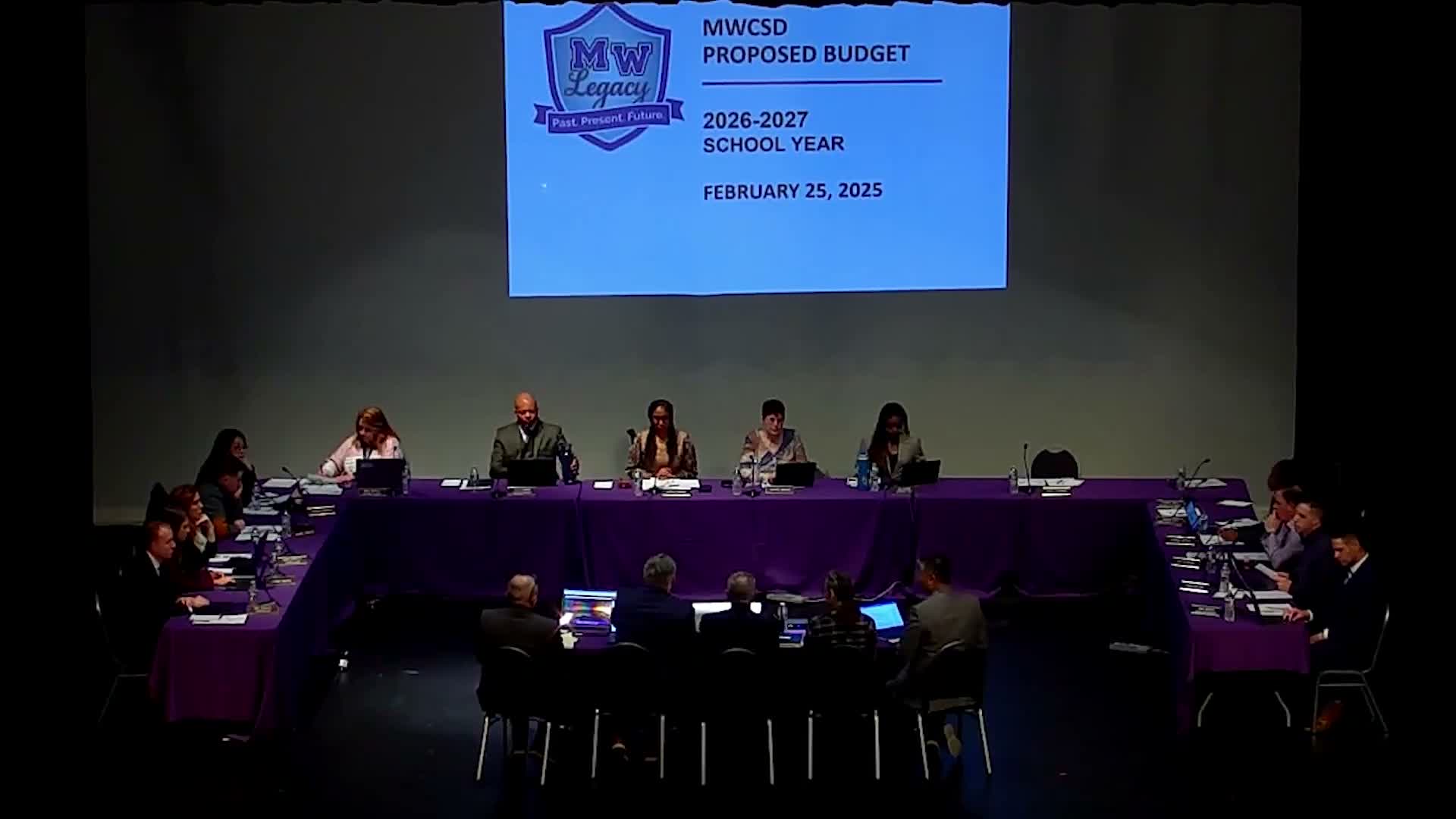
Summary
At a Jan. 25 board meeting the district’s assistant superintendent for business gave the first public review of next year’s noninstructional budget, flagging a state zero-emission bus mandate and a 7% projected rise in health‑insurance premiums as key cost drivers while noting state aid growth may help narrow the gap.
Patrick Cahill, assistant superintendent for business management services, opened the public review of Monroe‑Woodbury Central School District’s 2026–27 noninstructional budget and described several cost pressures the district is still finalizing.
Cahill said the state’s zero‑emission bus (ZEB) requirements mean any new bus purchased after July 1, 2027 must be electric, and that an initial quote for an electric bus was roughly $534,000 compared with about $200,000 for a conventional diesel bus. He said electrification also requires “a pretty substantial capital investment to essentially reconfigure our entire bus garage” to add charging infrastructure and related electrical work. Cahill noted districts can apply for temporary exemptions that can delay the mandate in some cases.
On benefits, Cahill said the district participates in a self‑insured Orange‑Ulster (OU) health plan with roughly 20 other districts and expects premiums to rise about 7% next year, driven in part by pharmacy cost trends. He gave example annual premium figures presented in the meeting packet — roughly $15,000 for single, $33,000 for two‑person and $39,000 for family coverage — and said employees currently pay about 12–15% of those premiums while the district covers the remainder.
Cahill also flagged a projected $1.3 million increase in non‑payroll special‑education costs and described modest changes to retirement rates (a small decrease to TRS employer rates and an increase in ERS contributions from 18% to 20%). On the revenue side he highlighted a roughly $3 million projected increase in foundation aid in the governor’s proposal but warned that some expense‑based aids (transportation, certain BOCES and special‑education excess‑cost aids) are variable and the district uses conservative budget‑to‑budget comparisons.
Cahill said the district will apply about $1.2 million from a long‑held debt service reserve tied to prior high‑school construction to retire remaining debt next year, which will help lower the levy pressure. He closed by outlining next steps and dates: tax‑cap submission March 1, further instructional budget presentations beginning March 4, superintendent recommendation April 8 and a projected board adoption April 21, with the public budget vote statewide on May 19.
Board members asked clarifying questions about the bus timeline and useful life of buses (Cahill said typical service life is about 10 years) and about how UPK (universal pre‑K) funding appears on the state aid run; Cahill and Superintendent Norman said UPK figures often reflect the maximum possible allocation based on full district participation and may not match the district’s current enrollments or accounting treatment.
The district characterized most figures as preliminary and said it will share more detailed cost and capital estimates as the budget process continues.