
CDCR outlines California Rehabilitation Center closure; lawmakers press on transfers, staff placement and property disposition
Get AI-powered insights, summaries, and transcripts
Subscribe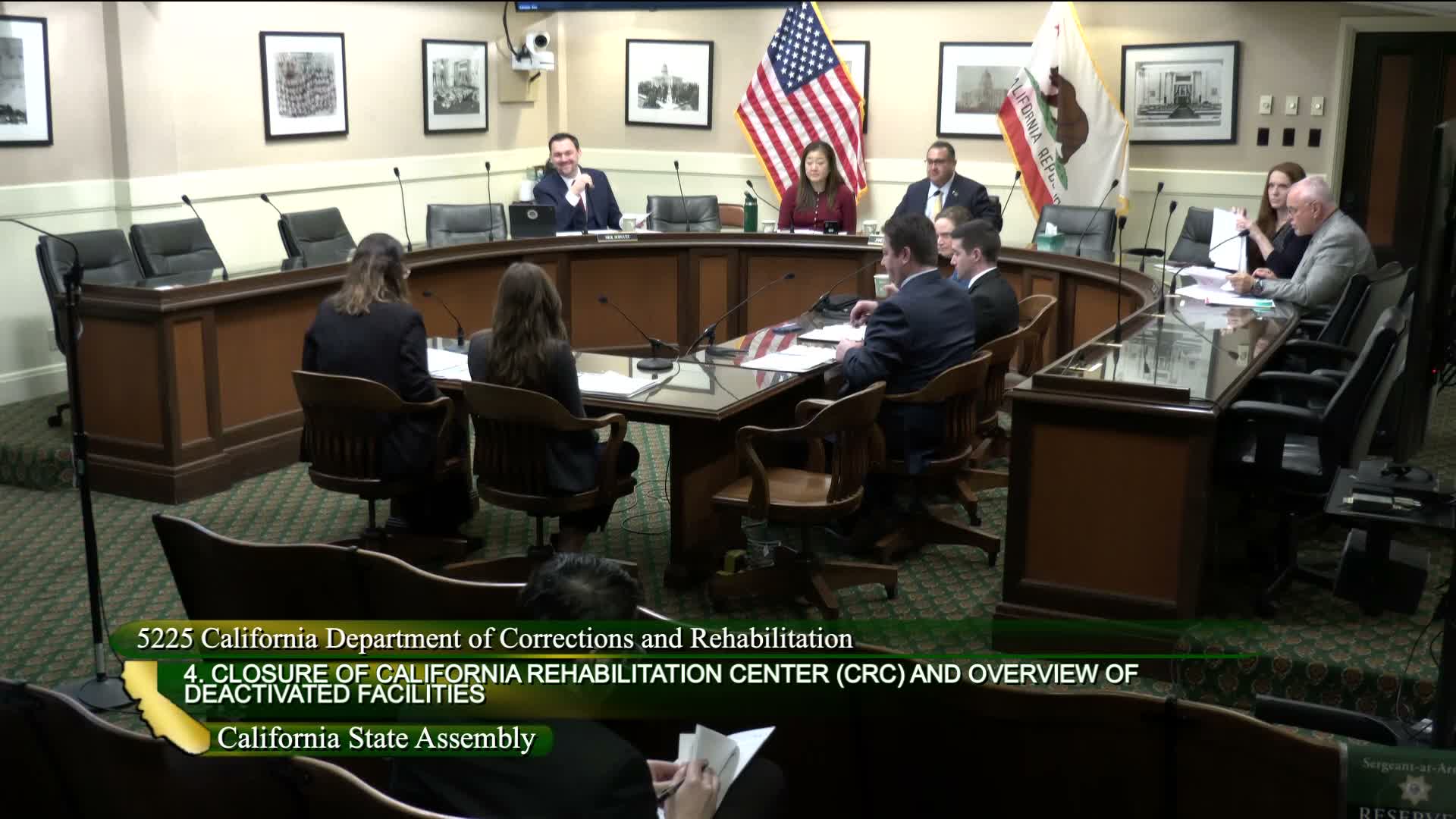
Summary
CDCR presented a plan to cold‑shutdown the California Rehabilitation Center by October 2026 with near‑term general fund savings and position eliminations. Lawmakers asked about preserving family visiting access, staff placement, and the Department of General Services surplus process for property disposal.
The Department of Corrections and Rehabilitation told the Assembly Budget Subcommittee No. 6 that it plans to transition the California Rehabilitation Center (CRC) to a cold shutdown beginning in October 2026 as a response to sustained declines in the adult prison population. "The department is requesting a net general funds decrease of 99,600,000.0 in an elimination of roughly 522 positions in 2026‑27 and ongoing general fund savings of over 150,000,000 and 778 positions starting in 2027‑28," Cynthia Mendonza said.
CDCR said the August 2025 announcement to close CRC is intended to generate savings while maintaining public safety, health care access and rehabilitative programming through population redistribution and targeted retention and realignment funding for continuity of services.
Lawmakers asked what considerations CDCR uses when transferring incarcerated people, including whether officials weigh visitor travel distances to preserve family connections. Lenny Shimoda, assistant deputy director for facility support, said that family location and program participation are among the factors considered and that CDCR attempts to place incarcerated people where family access and program completion can be preserved.
Committee members also pressed CDCR about staff options; the department described a placement process to move employees into open positions at nearby institutions when possible. On disposal of surplus properties, Sarah Larson explained that the Department of General Services (DGS) governs surplus declarations under a government code section cited in the hearing; DGS gives priority to local agencies proposing affordable housing or housing for formerly incarcerated people, but CDCR faces constraints because many closed facilities are remote and expensive to remediate.
Public commenters urged lawmakers to direct closure savings to community programs. The subcommittee did not vote on closure adjustments at this hearing; LAO said it had no concerns with the specific budget adjustments presented.