Palm Coast council debates charter overhaul focused on vacancies, election timing and borrowing limits
Loading...
Summary
At a Feb. 24 workshop the Charter Review Committee presented recommendations to tighten vacancy rules, set clearer special-election timelines and update the council—s contracting cap. Councilors prioritized three ballot issues and asked staff to refine timelines with the Supervisor of Elections.
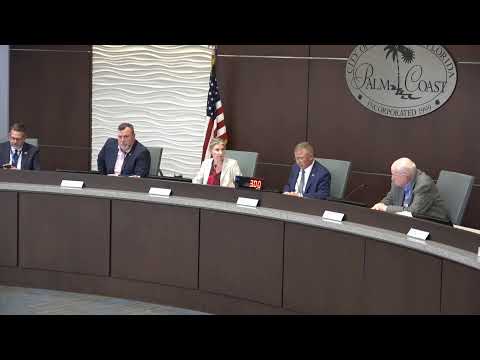
The Palm Coast City Council spent its Feb. 24 special workshop poring over a Charter Review Committee report that recommends changes to how vacancies are filled, how quickly special elections must be scheduled, and how high the council—s borrowing and contracting authority should be.
"Legally, you cannot change the charter without it going to referendum," said Dr. Georgette Dumont, the committee—s presenter, describing six months of town halls and committee work that produced the proposed revisions. The committee grouped recommendations by priority and warned against placing too many items on a single ballot.
Why it matters: The changes would alter procedures for appointed seats and shorten the time residents may be represented by unelected appointees. They would also update decades-old dollar thresholds the council can approve without a referendum — a point several members said needs indexing to current dollars to avoid locking future councils into outdated limits.
Key proposals and council guidance
- Vacancies and special elections: The committee proposed barring appointments to vacant seats if the vacancy occurs within six months of a scheduled election and requiring an election within 12 months of an appointment. It would also require the council to set a special-election date within 30 days when no county election is available. Mayor Norris urged a short timeline, noting a prior mayoral vacancy was resolved in about 72 days; others cautioned the council must coordinate with the Supervisor of Elections and consider cost and qualifying timelines.
- Borrowing and contracting limits: The report urged study and revision of the charter—s $15 million general-fund cap, which committee members said is outdated. Several councilors suggested $30 million as a rough inflation-adjusted starting point and asked staff to return with options tied to CPI and practical contract-length scenarios.
- Compensation and benefits: The committee recommended tying salary increases for the mayor and council to the city—s CPI adjustments and prohibiting retirement benefits or cash equivalents for elected officials. Council members generally supported indexing to CPI and eliminating retirement/cash-equivalent payouts while preserving access to health insurance.
What the council asked staff to do
Councilors did not adopt final language at the workshop, but they gave staff clear directions: consult the Supervisor of Elections on feasible timelines and qualifying windows for special elections; draft tighter text for vacancy and call-for-election provisions (council discussed 30-, 60-, 72- and 90-day targets); prepare an inflation-adjusted proposal for the contracting cap with options for term length and thresholds that would trigger supermajority approvals; and prepare ballot summaries that fit election-wording constraints.
On priorities, staff recorded three top items for a near-term ballot: the filling-vacancies rules (to address the recent vacancy loophole), a revised borrowing/contracting limit and clearer censure/removal language. Officials also asked that administrative cleanups and policy items be grouped for later consideration to avoid an overloaded ballot and voter confusion.
Quotes from the meeting
"If there's a vacancy, there's a vacancy. The mayor calls an election within 72 days," Mayor Norris said while urging a short special-election timetable. Vice Mayor Panieri and others urged balancing prompt elections with realistic qualifying windows and costs, and Dr. Dumont repeatedly emphasized the proposal—s intent to give voters a timely voice.
Next steps
Councilors asked staff to return with redlined language, an elections-timing feasibility analysis coordinated with elections officials and an options memo on a new borrowing cap and contract-duration limits. The council will workshop ballot wording and rank the final items to place on the next applicable ballot. No final votes on charter amendments were taken at the workshop.