
Legislative liaison briefs board on K–12 bills; vouchers data questioned
Get AI-powered insights, summaries, and transcripts
Subscribe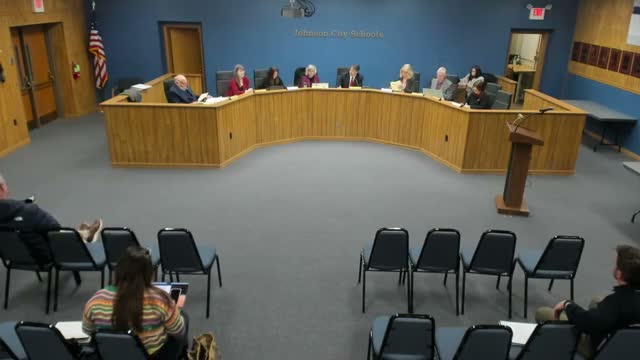
Summary
The district legislative liaison summarized current K–12 bills — including student transfer athletics eligibility, proposals restricting classroom device use and a constitutional amendment for local lotteries — and a board member said recent voucher data suggests about 82% of voucher applicants are not from public schools.
Miss Paulatrice, the district’s legislative liaison, briefed the board on several bills moving through the Tennessee General Assembly. She reported that HB25/SB16 was recently signed and generally allows certain transferring middle and high school students to become immediately eligible for interscholastic athletics under specified conditions. She also summarized bills under consideration, including proposals that would criminalize capturing images or video over school grounds when done with surveillance intent, and a constitutional amendment (HJR146) that would permit local boards to approve lotteries conducted by nonprofit school support organizations if advanced through the required multi‑session legislative process.
On device‑use legislation, Paulatrice flagged Senate Bill 2310 and House Bill 2393, describing proposals that would restrict students’ access to digital devices in lower grades and limit teacher use of digital devices for instruction in certain circumstances. "As introduced, it prohibits LEAs... from allowing students to access digital device at school," she said, noting hearings were scheduled that week.
Board member Mister Kinnick raised concerns about voucher data released by the Department of Education, saying he calculated that, after removing kindergarten applications and using available subtotals, "82% are not from public school." Kinnick cautioned the numbers are not crystal clear because the state reporting did not provide per‑grade detail and subtotals overlap; district members discussed the need for clearer state reporting.
The legislative update was provided for informational purposes; the board discussed contacting state legislators on selected items but took no formal position during the meeting.