
Board discusses 'courageous conversations' training and how mentors should handle a teacher's racially charged comments
Get AI-powered insights, summaries, and transcripts
Subscribe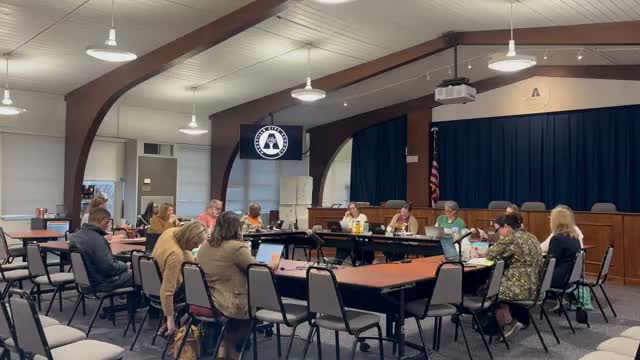
Summary
A facilitator walked the board through an exercise on running courageous conversations and a role-play where a teacher blamed students' behavior for racial gaps; board members debated probing strategies, systemic causes, and which metrics to use to measure 'success.'
A facilitator (S8) led the board through condition 4 of a series on facilitating courageous conversations, emphasizing guardrails such as time-outs and agreed norms to keep dialogues productive. S8 described an extended role-play in which a teacher becomes emotional and claims, "I don't care if students are green, blue, or purple...It is not my fault that black students are choosing to sleep during my class," and then leaves the meeting; S8 used the vignette to ask how a mentor should respond.
Board members responded with a mix of probing approaches and systemic framing. Committee member (S5) recommended asking the teacher to reflect on emotion and how that moment might be approached in a coaching conversation; Committee member (S6) urged the board to consider systemic and intergenerational factors that shape out-of-school conditions and student readiness. Committee member (S2) emphasized the training's instruction to 'isolate race' as one factor among many and warned against dropping race from the conversation when analyzing disparities.
Members also debated measurement approaches. S6 cited prior work that framed proficiency percentiles and warned that labeling students 'proficient' versus 'not proficient' often reflects relative percentiles rather than absolute mastery; several members asked staff to include broader metrics that show 'black success' as well as gaps.
The board recommended concrete supports: mentors should preview conversations with teachers, involve HR when needed, and provide resources such as in‑person mentoring sessions or summer professional learning. The training segment concluded with members asking staff to refine policy language and provide clearer guidance on how mentors and principals should prepare for and document sensitive coaching conversations.