Get AI Briefings, Transcripts & Alerts on Local & National Government Meetings — Forever.
Senate subcommittee reviews Department of Administration’s $350 million FY2027 proposal; members press over shared-services changes and OPA overtime
Summary
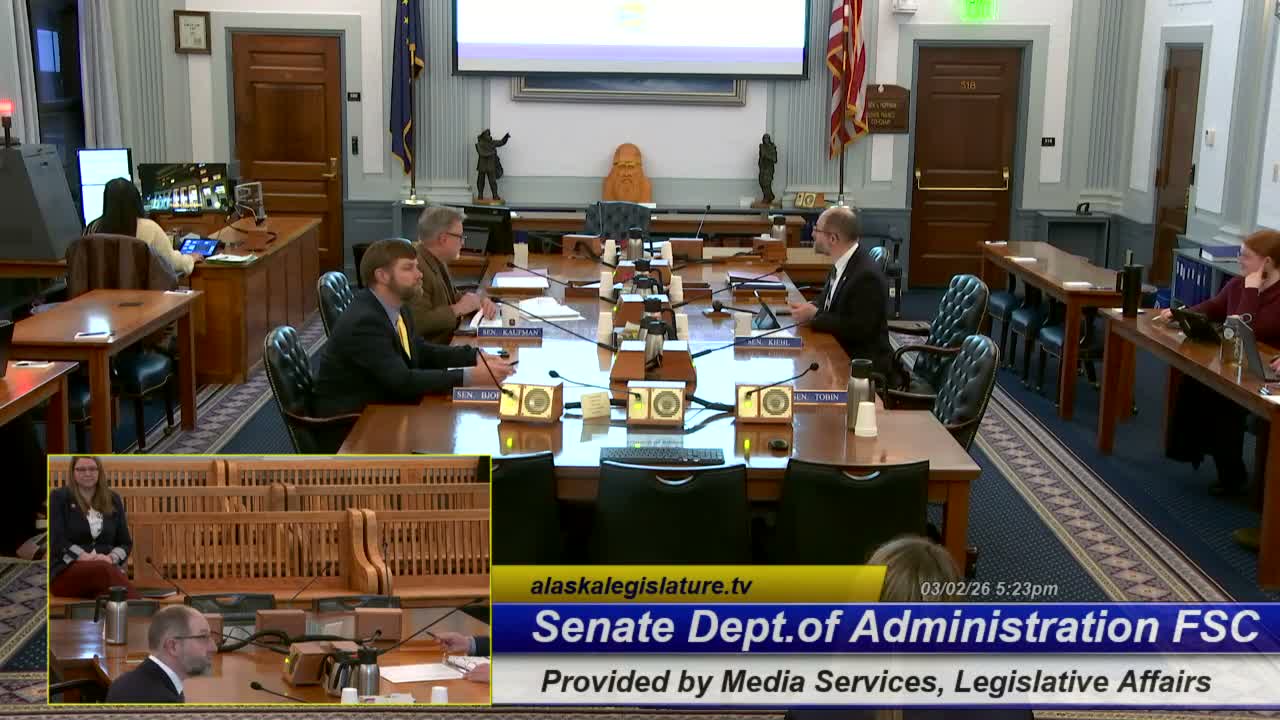
On March 2, 2026 the Senate Finance Subcommittee heard the Department of Administration’s FY2027 budget proposal totaling $350 million. Committee members pressed department leaders on the deconsolidation of Shared Services of Alaska, transfers of payroll positions, an IT job-class implementation and overtime and contract pressures at the Office of Public Advocacy.
The Senate Finance Subcommittee met March 2 to take the Department of Administration’s first look at the governor’s fiscal year 2027 budget proposal. Commissioner Paul Evrena, joined by Administrative Services Director Stephanie Bingham, presented the package and answered senators’ questions.
"The FY 2027 proposed budget totaled $350,000,000 across all funds," Commissioner Paul Evrena said as he opened the department’s presentation, describing the department’s work delivering IT, payroll, retirement and legal-support services for the state.
Bingham said the department’s FY2027 proposal includes $99,800,000 in unrestricted general funds, $36,500,000 in designated general funds and $212,300,000 in other funds, and she outlined allocations across result-delivery units. "The largest share for central administrative services [is] 104,800,000.0, the office of information technology is 68,200,000.0, and risk management at 35,200,000.0," she said.
Why it matters: the Department of Administration provides shared infrastructure—payroll, procurement, information technology, retirement and legal services—that other agencies rely on. Changes to how those services are organized can affect departmental workloads, hiring and the speed of service delivery across state government.
Shared services and payroll transfers Bingham told the committee that Shared Services of Alaska will be eliminated in the FY2027 proposal and that many functions will be returned to agencies after a survey by the Office of Management and Budget showed departments wanted some services managed in-house. She described transfers of 40 permanent full-time payroll positions back to eight departments: Corrections (8), Fish and Game (6), Law (1), Military & Veteran Affairs (1), Natural Resources (4), Public Safety (3) and the Department of Transportation & Public Facilities (17). One accountant position would transfer to the governor’s office.
Senators said they want a deeper follow-up. Chair Keel asked the department to return with a detailed analysis of the decision to decentralize, including expected costs and benefits and whether earlier consolidation savings can be preserved when positions move back to departments.
IT job-class changes and recruitment The presentation described an internal IT job-class study that "established 44 new job classes," Amy Tavares, division of personnel director, said; salary-range adjustments are included in the proposed budget. Tavares said the study was performed in-house with contractor support for job descriptions, and that the state used its existing pay plan rather than a separate external compensation study.
Vacancies and recruitment challenges Bingham presented vacancy trends showing a 12.8% overall vacancy rate for FY26 among full-time positions (1,222 positions budgeted; 1,060 filled; 165 vacant). She highlighted particularly high vacancy rates in finance and centralized administrative services and said deconsolidation was in part a response to persistent vacancies in payroll services.
Office of Public Advocacy overtime and contractor costs Senator Bjorkman asked whether overtime controls at the Office of Public Advocacy (OPA) had reduced guardianship and guardian ad litem capacity. James Simpson, OPA director, said rising criminal-trial volume and higher contractor pay drove deficits in the contractor line and overtime needs. "Because of the high pace of criminal trials and increased rates of contractor pay, we're having a significant deficit in our contractor line, primarily for criminal cases," Simpson said, adding the pressure "caused some significant pain within the public guardian section."
Senators flagged downstream impacts such as hospital stays tied to delays in guardianship or related representation and asked for additional data on how many patients might be affected.
Procurement training and customer satisfaction Tom Mayer described efforts to improve procurement performance after audit findings, focusing on training and assessment. Mayer said the department moved from an external customer-satisfaction score of about 1.3 to roughly 3.6 through quarterly outreach and enhanced training, and he described plans for follow-up testing to sustain improvement.
Follow-ups and next steps Committee members requested more detailed information on (1) historic budget accuracy and supplementals, (2) corrective actions and closure on the 2024 audit, and (3) a deeper analysis of the shared-services deconsolidation with cost/benefit and staffing-hour implications. Bingham agreed to provide the requested follow-up materials. The subcommittee scheduled its next meeting for March 9 at 5:15 p.m.
The hearing closed after Chair Keel disclosed that members of his household are Department of Administration employees and that a household member could be affected by the IT job-class changes; he said there were no conflicts of interest and the committee adjourned.