
Committee hears bill to redirect some employer UI taxes into state training while keeping solvency safeguards
Get AI-powered insights, summaries, and transcripts
Subscribe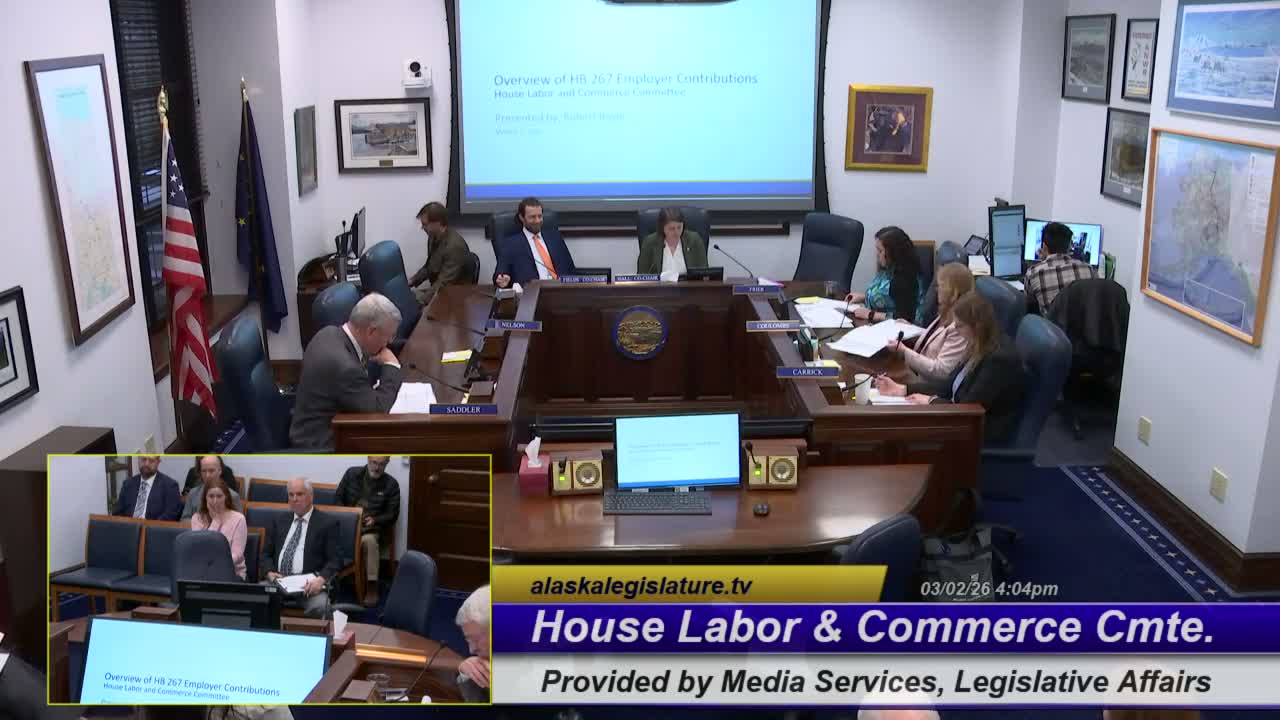
Summary
HB 267 would let employer UI tax rates fall when the Unemployment Insurance trust is overcapitalized and redirect a portion of employer contributions into the State Training and Employment Program (STEP) until solvency metrics require restoring UI contributions. DOLWD officials presented fund balances and long‑range projections.
A governor‑sponsored bill, HB 267, was heard March 2 by the House Labor and Commerce Committee. Robert Boyle (policy advisor to the governor) and Paloma Harbor (director, Division of Employment and Training Services, Department of Labor and Workforce Development) said the legislation would permit employers’ statutory UI tax rate to decline and instead direct a new employer STEP tax (presented as 0.4% in testimony) into workforce training programs while preserving the UI trust fund’s long‑term solvency.
DOLWD data presented: Paloma Harbor said the UI Trust Fund reached roughly $821 million as of November 2025 and currently exceeds the statutory solvency target (a reserve ratio target cited as 3–3.3% of wages). Harbor and Boyle showed projected reserve‑ratio paths through 2040 under the bill’s mechanics and described how employer STEP contributions would be reduced or reallocated once solvency levels require UI contributions to resume. Testimony included an illustrative employer savings figure of about $68 million in calendar year 2027 under the proposed reallocation.
Key mechanics explained to the committee: under the bill employers with at least one year of experience could see UI taxes reduced toward zero so long as the trust fund’s solvency warrants it; employers would instead pay the STEP tax (described in testimony as 0.4%) that funds state workforce and apprenticeship programs. When reserve ratios approach statutory targets, employers would again begin contributing to the UI trust fund and STEP contributions would be adjusted accordingly.
Committee questions: members sought historical context for the trust fund (pre‑2019 trends), asked how employer rate classes and penalty‑rate classes interact with the proposal, and raised concerns about public awareness that employer taxes would shift to training rather than UI. Harbor said the bill preserves the statutory mechanisms that restore employer UI contributions when solvency erodes and promised to provide additional historical charts and technical fiscal notes.
Outcome: The committee heard testimony, asked technical questions, and set the bill aside for further work; no vote was taken at this hearing.