Get Full Government Meeting Transcripts, Videos, & Alerts Forever!
Get email alerts on the Solar Zoning topic
No spam. Unsubscribe anytime.
York County commissioners press staff to tighten proposed solar zoning rules on setbacks, screening and decommissioning
Summary
Commissioners began a page-by-page review of proposed solar regulations, debating whether projects that meet setbacks should still require conditional-use approval, how to define screening and tree-maturity standards, escrow and enforcement language, and stronger decommissioning/indemnification provisions to protect the county.
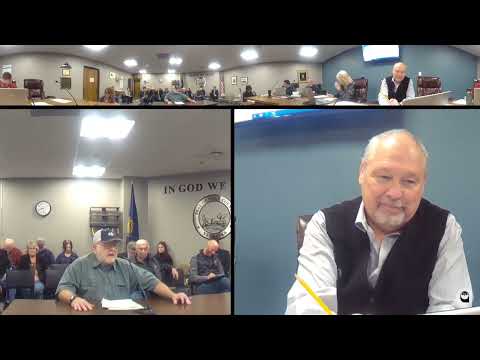
York County commissioners spent a large portion of their Feb. 20 meeting scrutinizing proposed solar energy conversion system (CSECS) regulations, raising questions about conditional-use permitting, screening and how the county will enforce decommissioning and related financial safeguards.
Commissioners and staff traded detailed technical questions during a page-by-page review of the draft rules. At issue were whether a project that meets the published setbacks should still need a separate conditional-use permit and whether the planning commission should be able to require additional testing or whether that authority should rest with the elected board. "My opinion is to strike the planning commission from being able to require any other testing," the chair said, asking that such requirements be recommended to the board rather than imposed by an appointed body.
Zoning staff flagged several drafting points that need clarification. A staff member noted they had circulated two documents with recommended approvals and denials and said, "I attached two documents... I'm recommending for approval" for the majority of applications; the staff also said some applications (for example, a parcel involving leased land at York University and several partial-improvement applications such as a daycare and a church-related office) should be denied or cleaned up administratively.
Commissioners pressed for clearer definitions on screening and landscaping. One commissioner asked whether the screening standard—"cover a 100% of the surface area of the vertical plane extending along the property line"—meant screening across the full property line or only in front of the dwelling, and raised concerns that the draft specifies tree counts but not maturity at planting: "If you plant a seedling tree according to this, it would be fine, and that's not really going to be screening for 10 or 15 years."
Financial and enforcement provisions drew sustained attention. Commissioners noted the proposed escrow accounts for application review and for complaint investigation but argued the draft lacked enforcement "teeth"—deadlines, penalties or automatic consequences if escrow deposits are not replenished or if post-construction studies (noise studies, for example) show exceedances. One commissioner asked whether the "substantial need for the proposed use of CSECS greater than 100 kilowatts" standard should be localized (county or state) rather than a global claim that could be satisfied anywhere.
The board also sought clearer language on road-use agreements and damage assessments tied to construction and operations, recommending the county highway department be explicitly involved when assessing damages. On decommissioning, several commissioners emphasized they wanted contractual and escrow language that would prevent the county from inheriting cleanup responsibility if a developer becomes defunct: "I wanna make sure that it's not your county's job to clean that up," one commissioner said.
Why it matters: York County is finalizing rules that will govern where and how utility-scale and larger private solar projects may be sited. The technical choices—how screening is measured and enforced, whether a conditional-use process applies, and how decommissioning is guaranteed—will determine how easily projects can be developed and how much financial and operational risk remains with landowners, developers and the county.
What’s next: Staff said they will resend missing materials and refine wording on screening, escrow replenishment, indemnification and decommissioning. The board set a procedural hearing date for March 19 for mass action on certain applications and asked staff to prepare clearer, enforceable standards ahead of that meeting.