
House Finance hears DMVA disaster funding request as Halong bills mount
Get AI-powered insights, summaries, and transcripts
Subscribe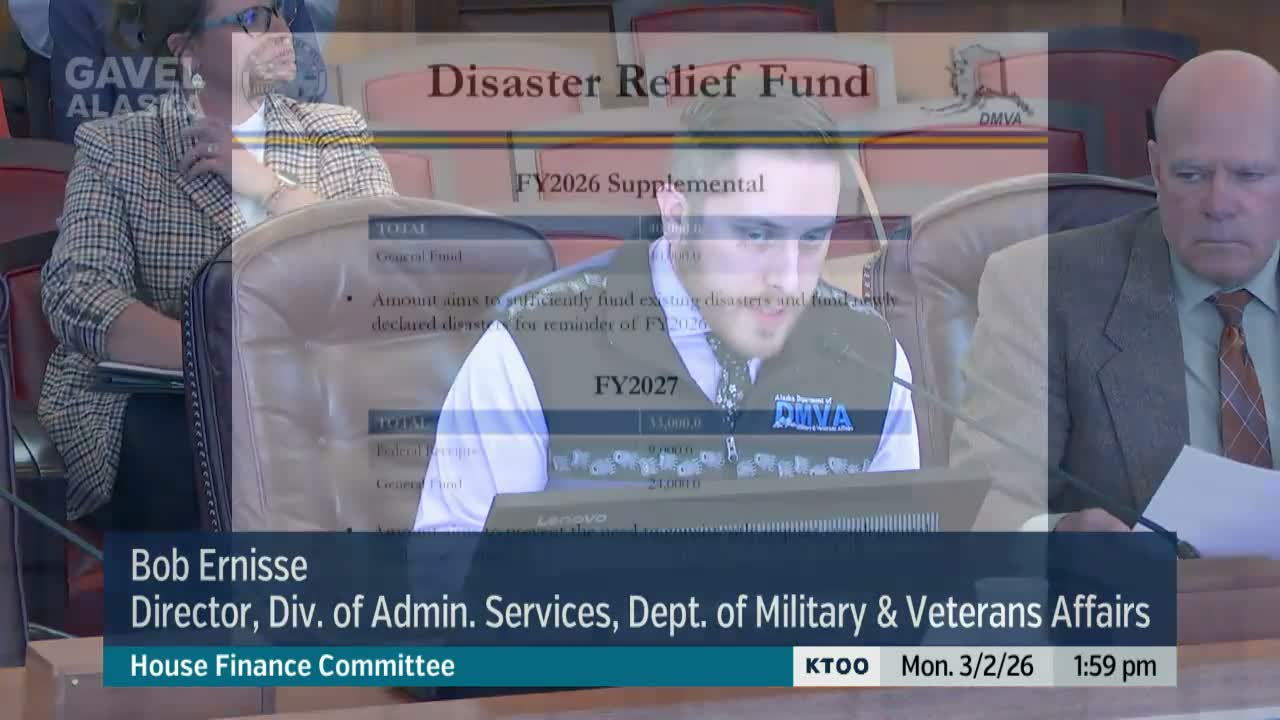
Summary
Department of Military and Veterans Affairs officials told the House Finance Committee they are covering Halong response costs now but will need additional state funds later this fiscal year; DHSEM said FEMA has provided about $35 million so far and the state is paying roughly $4 million per month for hoteling survivors.
Juneau — The Alaska House Finance Committee on March 2 heard Department of Military and Veterans Affairs (DMVA) officials lay out FY27 budget requests and a supplemental ask tied to recovery from the Halong storm.
Brian Fisher, director of the Division of Homeland Security and Emergency Management (DHSEM), said federal assistance has already arrived but state bills remain. "So far, FEMA has already, extended approximately $35,000,000 in federal funds," Fisher said, and added that "we're running approximately $4,000,000 a month" to house displaced residents in hotels as the state moves people into longer‑term housing.
Fisher told the committee the state is paying incoming vendor bills as they arrive but will need additional appropriation authority for the remainder of the fiscal year. He said "as of today, the state owes approximately 7 and a half or $8,000,000 to FEMA" for a portion of individual assistance obligations tied to the response.
DMVA Administrative Services Director Bob Ernesi outlined the department's FY27 request, noting most items seek additional federal receipt authority rather than new general fund (GF) appropriations. Ernesi said DMVA's FY27 ask includes two federally reimbursed program managers (one each in Fairbanks and Anchorage) and two environmental program specialist positions under the National Guard cooperative agreement for hazardous spill response and safe drinking water work.
Committee members pressed for the current accounting of response costs. Fisher said DHSEM submitted a revised financing plan to the legislature and continues daily accounting work; he described the process of assembling bills, documenting expenditures, and working with FEMA on reimbursement eligibility.
Co‑Chair Josephson questioned the supplemental dollar amount presented on a DMVA slide; Ernesi and Fisher clarified the slide values and Fisher explained the supplemental funding is primarily to cover Halong expenses — including evacuations, sheltering and ongoing housing support.
The committee did not take formal action; members asked staff and DMVA for updated financial detail and invoices to better understand near‑term cash‑flow needs and the projected supplemental request for the remainder of the fiscal year.