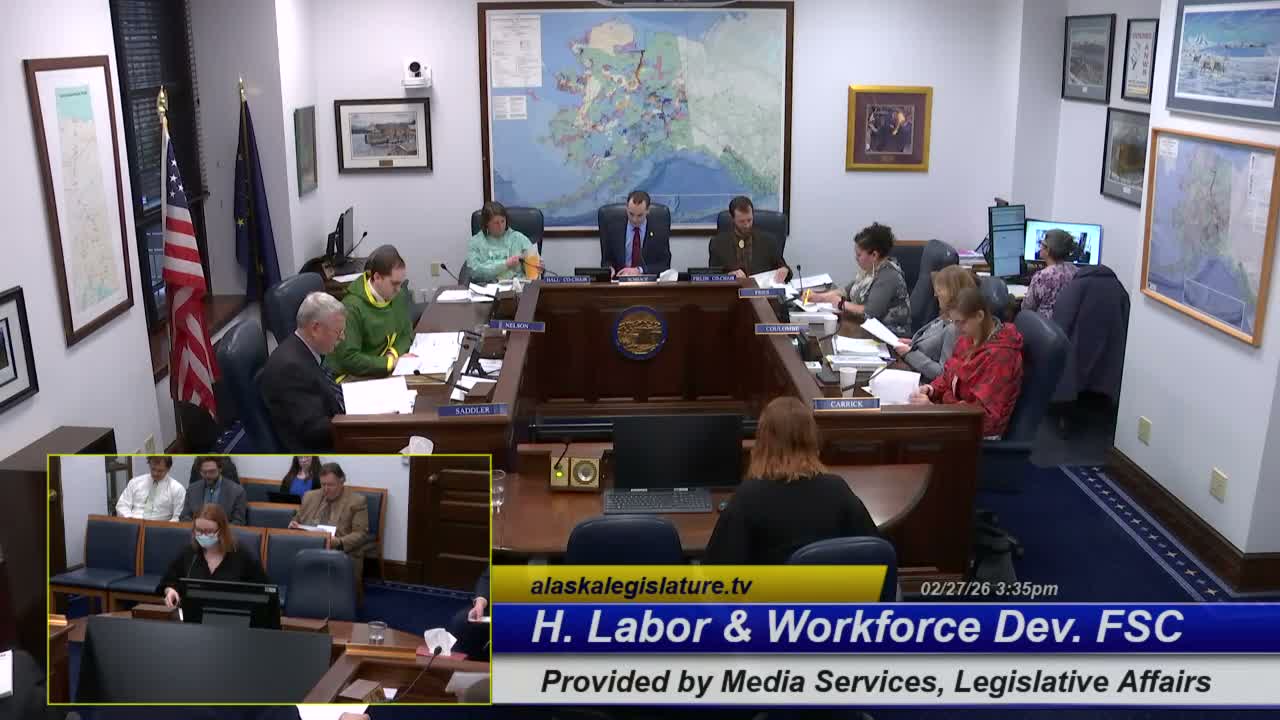
House subcommittee advances Labor Department budget after debate over Office of Citizenship Assistance
Get AI-powered insights, summaries, and transcripts
SubscribeSummary
On Feb. 27, 2026, the Alaska House Finance Department of Labor and Workforce Development subcommittee moved the department's FY27 operating budget out of subcommittee after approving a funding‑source swap to preserve the Office of Citizenship Assistance, passing a timber‑receipt swap for workers' compensation, and rejecting a split‑position amendment 4–4.
JUNEAU — The Alaska House Finance Department of Labor and Workforce Development subcommittee on Friday advanced the department’s FY27 operating budget recommendation to the full House Finance Committee after several hours of technical briefings and debate over staff positions and a small office that helps new Alaskans access employment and state services.
Chair Shrogy called the meeting to order at 3:34 p.m. and, after a review of the Legislative Finance VA (working) report, allowed member amendments. The subcommittee directed nonpartisan Legislative Finance staff to make conforming and technical changes and then moved the package out of committee without objection.
Why it matters: Members balanced two priorities — constraining general fund spending amid a tight fiscal outlook and preserving an office that staff and some lawmakers said helps integrate recently arrived residents into Alaska jobs and services. The resulting package keeps open the Office of Citizenship Assistance’s (OCA) functions for now by changing the proposed UGF deletion to a different fund source and makes several one‑time fund adjustments tied to agency technical corrections.
Legislative briefing and technical corrections Valerie Rose, fiscal analyst with the Legislative Finance Division, told members that several line items in the VA report are technical fixes: transfers of Technical Education Vocational Program (TVEP) authority and corrections that rebalance a transaction that was incorrectly recorded in the number section instead of the language section. She said the misflagging created a negative fund source in the commissioner’s office that the BA sheet corrects.
Dan DeBartolo, the Department of Labor’s administrative services director, said a roughly $650,000 reduction in projected interagency and federal receipts reflected normal grant‑funding fluctuations rather than the elimination of a federal program. He warned members these administration and overhead figures can vary as federal grant structures change.
Office of Citizenship Assistance and refugee support services Members spent extended time on item 9, which the VA sheet originally deleted and which would have eliminated the Office of Citizenship Assistance (OCA). Adam Weinert, special assistant to the commissioner for the Department of Labor and Workforce Development, described OCA services as employment assistance, workers'‑rights education, referral services for immigration questions (not direct immigration legal services), English‑conversation support and community outreach. He said OCA staff have been working with the Alaska Workforce Investment Board (AWIB) and other partners to prepare for federal refugee‑support‑services (RSS) funds that are being routed to states rather than to intermediary nonprofits.
Weinert reported that, in 2025, OCA assisted "over 150" new Alaskans with employment, helped more than 200 people with immigration‑related questions and handled about 60 inquiries related to workplace protections; Chair Shrogy referenced a total of 268 people served in 2025. Weinert cautioned that reducing staff could impede outreach to communities outside Anchorage and make it harder to get people into the workforce quickly.
Arguments for and against Representative Fields said she was reluctant to cut the office but felt fiscal realities — including pressures on school funding and a constrained budget outlook — forced difficult choices. "I don't feel like I have a lot of good choices," Fields said, describing trade‑offs between education and departmental operations.
Several members, including Representative Colomes, Representative Klum and Representative Kerrick, urged retaining OCA. Representative Klum said job centers are already stretched and that the specialized outreach and translation capacity OCA provides cannot be easily replicated inside existing job centers.
Amendments and votes - Conceptual Amendment 1 (Representative Fields): Change the proposed $478,900 UGF deletion for the Office of Citizenship Assistance to a fund‑source change from UGF to DGF (allowing the department to pursue federal or dedicated funds). After floor discussion and department cautions about uncertain federal flow, the conceptual amendment was approved without objection and became part of the working BA sheet.
- Amendment 1 (Representative Colomes): Use timber‑receipt account dollars to provide a $1.4 million one‑time increment to workers' compensation operations rather than UGF. Legislative staff verified the timber receipt account has available dollars for a one‑time swap; the amendment passed without objection.
- Conceptual Amendment 2 (Representative Sadler): Delete funding for the vacant deputy commissioner position (funded with interagency receipts) while preserving the general‑funded Juneau legislative liaison (a special assistant) to retain a Juneau presence. After debate, the roll‑call vote was 4 yays and 4 nays, and the amendment failed.
Final action and next steps With the VA sheet as the working document and the approved amendments included, the subcommittee voted to move the FY27 Department of Labor and Workforce Development operating budget recommendation out of subcommittee to the full House Finance Committee; the motion passed without objection. The subcommittee directed Legislative Finance to make any conforming or technical edits.
What remains unresolved Department staff and Legislative Finance cautioned that the flow and adequacy of alternative fund sources (the DGF referenced in Conceptual Amendment 1 and the timber‑receipt swap) are not fully guaranteed for future fiscal years; members asked the department to provide follow‑up details on how functions could be integrated into job centers or otherwise sustained if dedicated grant dollars do not materialize.
The subcommittee adjourned at 4:23 p.m.
(Reporting in this article relies solely on the public subcommittee transcript of the Feb. 27, 2026 meeting and statements made on the record by staff and members. Transcript spelling of some staff and member names varies in the record; the article uses the spellings that appear most frequently in the transcript.)