
State geologist: Alaska’s mines produced an estimated $5.58 billion in 2025 as exploration surges
Get AI-powered insights, summaries, and transcripts
Subscribe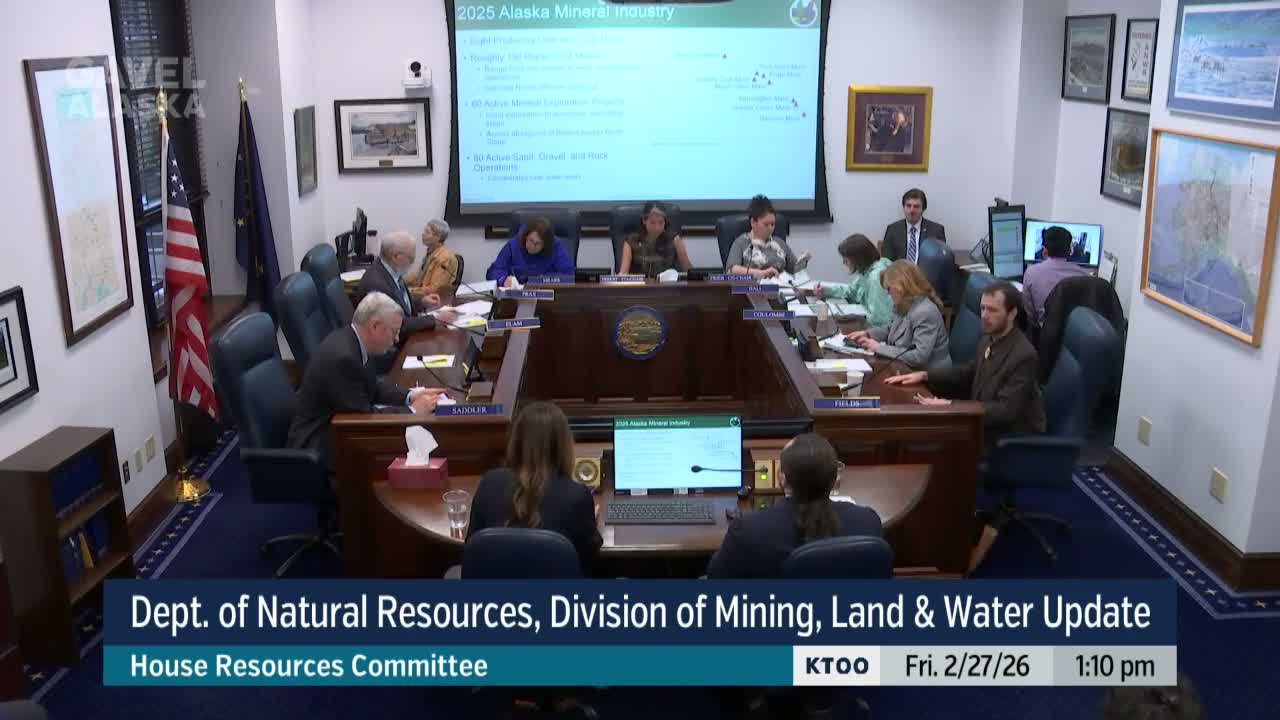
Summary
Alaska’s state geologist told the House Resources Committee that the state’s mines had an estimated $5.58 billion production value in 2025, the state ranks highly for geological potential and exploration activity is increasing, but final 2025 data and job counts for smaller placer operations remain incomplete.
Erin Campbell, Alaska state geologist and director of the Division of Geological and Geophysical Surveys, told the House Resources Committee on Feb. 27 that Alaska’s mineral industry generated an estimated $5,580,000,000 in production value in 2025, a figure calculated using average 2025 metal prices and forecasted fourth‑quarter production.
Campbell said the estimate is provisional because final 2025 production numbers were not yet fully recorded and the division forecasted the fourth quarter. “The reason this is an estimate is because the 2025 numbers are not yet fully recorded, and we've had to forecast the fourth quarter production,” she said. She noted the division will publish final figures in its 2025 minerals report when full data are available.
The presentation outlined the composition of Alaska’s mining sector: roughly eight large metal and coal mines (the presentation named the Usibelli Coal Mine among them), about 150 placer gold operations (typically one to 25 employees), roughly 60 active exploration projects and about 80 aggregate sites for construction materials. Campbell emphasized the distinction between 'resources' (what the state has identified in the ground) and 'reserves' (what can be produced economically), and said only about 20–23% of Alaska has geologic map coverage at the appropriate scale.
Campbell stressed Alaska’s global geologic significance: the state ranks first for mineral potential in the Fraser Institute’s 2024 survey and has many of the minerals listed on the 2025 U.S. critical minerals list. She walked lawmakers through exploration hotspots, naming major projects including Donlin (described in the presentation as the Donlin Gold Project), Pogo, Fort Knox, and the Red Dog complex. On Red Dog, she said the company has indicated ore will be exhausted around 2031 and that the operator is accelerating exploration of satellite deposits.
Committee members pressed for more economic detail. Representative Fields asked whether production value approximates gross revenue and whether the department could estimate pretax profit; Campbell cautioned against simple subtractions: “That is the number that is generally reported by other jurisdictions. We haven't subtracted out the taxes and expenditures because they can be difficult to forecast before the mining companies report them,” she said and offered to follow up with additional research. The committee also requested figures on how many full‑time jobs are associated with the 150 placer mines; Campbell said that information was not currently available and promised to research it.
Campbell highlighted DGGS’s role in attracting exploration—public geologic maps, airborne geophysics and a newly certified hyperspectral scanner will be used to scan samples starting in March—and credited federal Earth MRI funding for much of the recent mapping work. She gave examples of discoveries supported by state data, including an Alaska Silver Corp. discovery near Illinois Creek that leveraged airborne geophysics funded by a prior capital project.
The presentation noted state and local fiscal impacts that remain preliminary: the DGGS compilation gives an approximate state revenue contribution of $97,500,000 (including royalties, mining license tax, claim rentals and fees), municipal receipts around $48,600,000 and Native/regional/village corporation receipts around $215,400,000, with the caveat that 2025 numbers are estimates pending final reporting.
The presentation closed with a slide listing potential new mines (projects with permitting in process) and a reminder that the Office of Project Management and Permitting will provide detail on permitting timelines for projects that opt into coordinated review.
The committee did not take any formal action. Members asked for follow‑up information on job counts, corporate tax contributions and more granular fiscal comparisons; DGGS agreed to provide those details.