Get Full Government Meeting Transcripts, Videos, & Alerts Forever!
Get email alerts on the Transmission topic
No spam. Unsubscribe anytime.
Grid United outlines 2,000 MW North Plains Connector and landowner approach
Summary
Grid United presented the North Plains Connector — a proposed HVDC intertie designed to substantially increase East‑West transfer capacity — and emphasized extensive early landowner engagement, flexible micrositing and compensation practices to limit opposition and erosion of local trust.
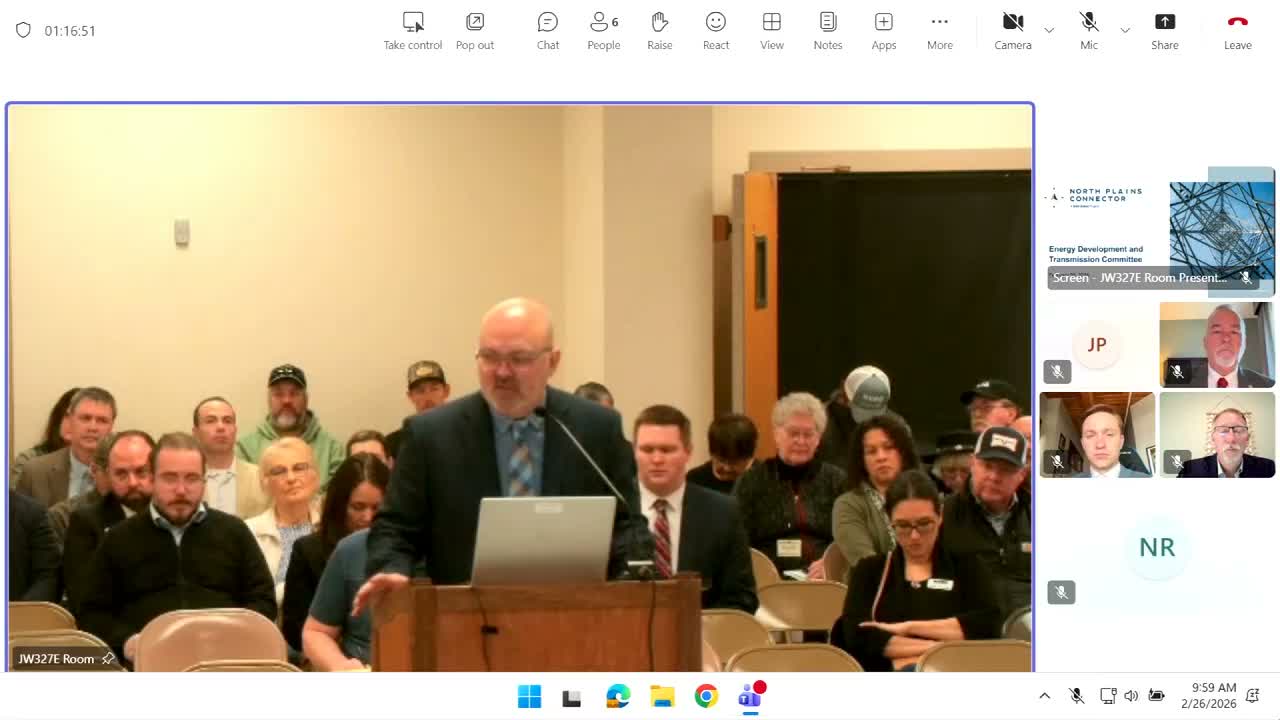
Grid United told the Energy Development and Transmission Committee that the North Plains Connector is proposed as a high‑voltage direct current intertie capable of moving roughly 2,000 megawatts between the Western Interconnect and the SPP/MISO regions.
Brent Johnson, Grid United senior development president, said the project design includes roughly 168 miles of HVDC in North Dakota, plus AC ‘‘forks’’ to connect into both regional transmission organizations. He said federal environmental review is underway (DOE EIS) and that the company has filed for a certificate of corridor compatibility and route permit with the North Dakota Public Service Commission.
Johnson stressed that the company prioritized route decisions and regulator engagement before showing maps to landowners to avoid surprise and opposition. "The first conversation we want to have with a landowner is about a potential route on their property," he said, adding that the developer emphasized voluntary acquisition, pragmatic micrositing (sticking to field edges, avoiding cutting across fields), compensated survey and document review, and paying landowners at or above market rates for right‑of‑way and temporary workspace.
He described 400 route changes from initial concept to current routing, and said the firm had set internal targets (for example, a high percentage of voluntary agreements before proceeding to counties) to reduce the need for condemnation.
Committee members asked about tax revenue sharing, co‑location with existing right‑of‑way and local permitting. Johnson said the team had worked with counties, townships and regulators early, and that tax and property‑tax impacts vary by county and by type of facility built.
The presentation underlined the technical scale of long‑distance interties and the operational need to integrate both grids, while framing the project as one that hopes to limit disputes through proactive route design, multiple open houses and repeated, face‑to‑face landowner contacts.