
ND interim committee endorses study and pilot to scale geothermal energy
Get AI-powered insights, summaries, and transcripts
Subscribe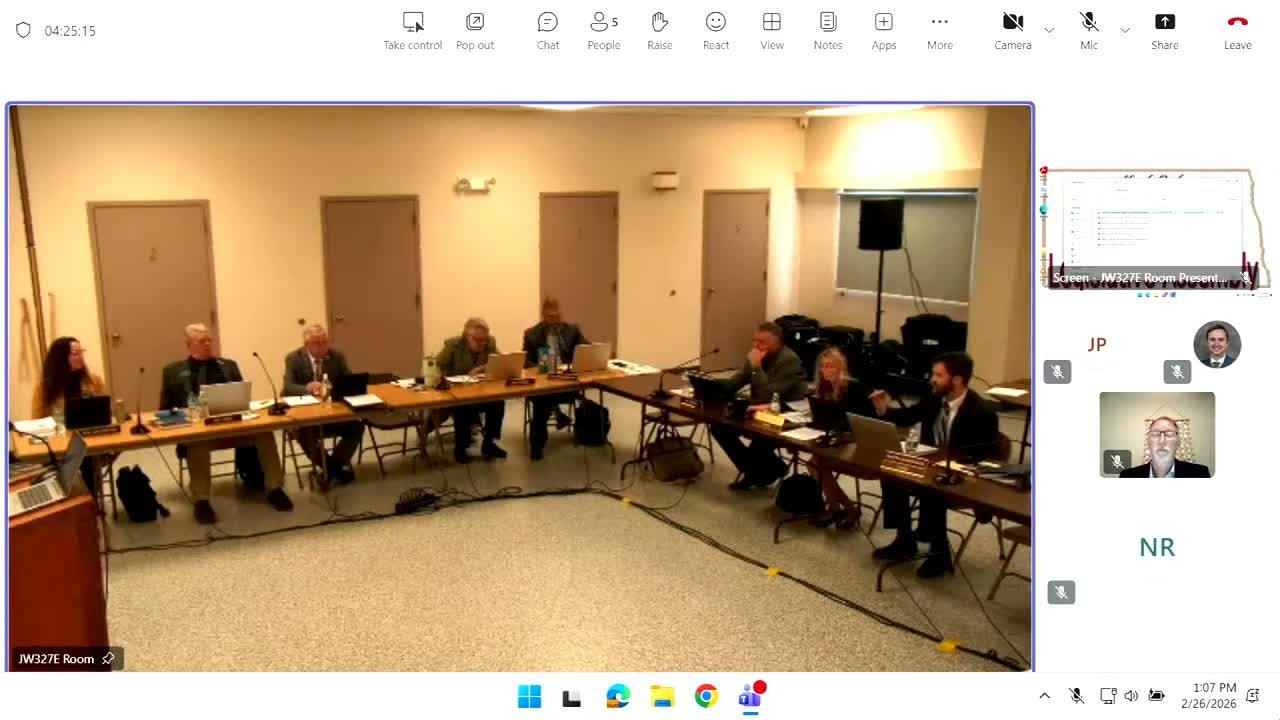
Summary
The Energy Development and Transmission Committee voted to recommend funding a comprehensive geothermal feasibility study, a pilot demonstration and regulatory steps to help North Dakota compete for federal geothermal development funding and repurpose nonproductive oil wells into long-term energy assets.
The Energy Development and Transmission Committee on Thursday voted to recommend a funded feasibility study and pilot program aimed at scaling geothermal energy in North Dakota.
The committee, chaired by Representative Anna Novak, heard more than two hours of technical testimony from university researchers, federal and industry representatives and recommended a package of steps to convert the state's extensive subsurface data and oil‑field infrastructure into dispatchable, low‑carbon baseload power.
The motion, introduced by Senator Hogan and seconded by Representative Anderson, asked the Industrial Commission, UND energy and petroleum engineering, and Geothermal Rising to outline next steps including a site‑specific feasibility study, a pilot demonstration using repurposed wells, a geothermal permitting and royalty framework, and a plan to match and leverage available federal grants. The recommendation passed by voice vote.
UND researchers and the Energy & Environmental Research Center said that North Dakota is unusually well positioned for geothermal because of decades of oil‑field data and a large inventory of drilled wells that could be repurposed. Dr. Muniz Alamouti of UND described a university‑built binary pilot plant that generated electricity at a reported levelized cost near six cents per kilowatt‑hour and said repurposing nonproductive wells can convert an orphan‑well liability into a long‑lived revenue stream.
"North Dakota spent 40 years building the science," Alamouti told the committee. "The geology is there. The technology is ready. The regulations are not — and that is fixable." He urged a feasibility study with site‑specific engineering, grid‑interconnection analysis and an explicit plan to access federal funding now available for enhanced geothermal demonstrations.
State and federal researchers, plus industry representatives, emphasized the variety of geothermal uses: utility‑scale binary power plants where temperatures permit, behind‑the‑meter electricity or industrial use at smaller scales, and low‑temperature direct uses such as grain drying, greenhouses or district heating that can dramatically lower fuel costs for farmers and towns.
Supporters pointed to federal funding windows and tax credits still available for geothermal projects through the 2030s, saying early state action would increase the chances of capturing competitive federal awards. Opponents did not appear in the hearing record; public commenters focused on landowner transparency for other projects.
The committee asked agencies and university partners to return with a concrete outline for the study and pilot site selection, noting the need to coordinate permitting across the Department of Mineral Resources, Industrial Commission and State Water Commission. Next procedural steps include drafting a study scope and identifying state match options to position North Dakota for DOE competitive awards.
The committee will track the study's progress and consider legislative follow‑up during the 2026 session.