Get Full Government Meeting Transcripts, Videos, & Alerts Forever!
Get email alerts on the School Safety topic
No spam. Unsubscribe anytime.
Red Lake Public School District explains Standard Response Protocol and five emergency actions
Summary
A presenter for Red Lake Public School District outlined the Standard Response Protocol—used by the district to guide responses to incidents—describing the five actions (hold, secure, lockdown, evacuate, shelter), how each works in practice, and that SRP complements other safety plans.
A presenter for Red Lake Public School District said the safety of students and staff is the district's top priority and introduced the Standard Response Protocol (SRP) as the district's chosen tool for responding to campus incidents. "Nothing is more important than the safety of our students and staff in our schools," the presenter said.
The presenter said SRP, created by the I Love You Guys Foundation, is used in more than 45,000 schools, agencies and organizations worldwide and provides common language to identify five possible actions during an incident. "The actions are hold, secure, lockdown, evacuate, and shelter," the presenter said.
Under the SRP, a "hold" is used when something is happening in the halls or an area of the building — for example a student or staff medical issue — and teachers keep students in class, lock doors, take attendance and continue instruction until an all-clear is given. A meeting participant noted that learning can continue during a hold but students are not allowed to leave class even if the bell rings.
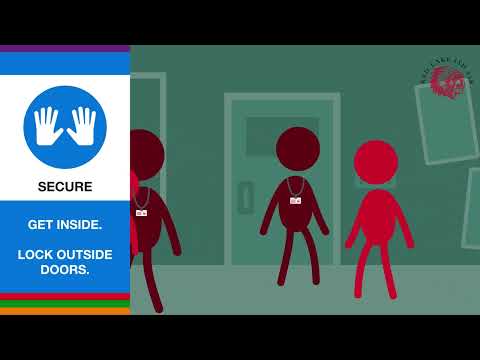
A "secure" is called when a threat or hazard is believed to be outside the building or in the neighborhood, such as a dangerous animal or criminal activity. Exterior doors are locked, no one may enter or leave the building, outdoor classes are brought indoors and activities inside continue while staff track attendance.
A "lockdown" is the most serious action, used when a threat is believed to be inside the school building (for example a threatening intruder). During a lockdown, no one may enter or leave, lights are turned off, students and staff move out of sight, teachers take attendance and everyone remains silent until police and school administrators declare areas safe.
An "evacuate" order is used for hazards that require leaving the building, such as fire, power outage or a gas leak; teachers lead students to a designated location, take attendance and await further guidance about whether students will return to school or be picked up by parents. A "shelter" is most commonly used for severe weather and may keep students in classrooms or move them to designated safe locations inside the school.
The presenter emphasized that local law enforcement and emergency responders also understand the SRP and that common language between students, staff, first responders and parents is important during crises. The presenter clarified that SRP is not a replacement for existing school safety plans or programs and works alongside other protocols such as ALICE.
For more information, the presenter directed listeners to the district website. The transcript did not specify a date for this announcement.