
Sheridan safety study flags high crash counts, recommends medians, lighting and sidewalks
Get AI-powered insights, summaries, and transcripts
Sign Up Free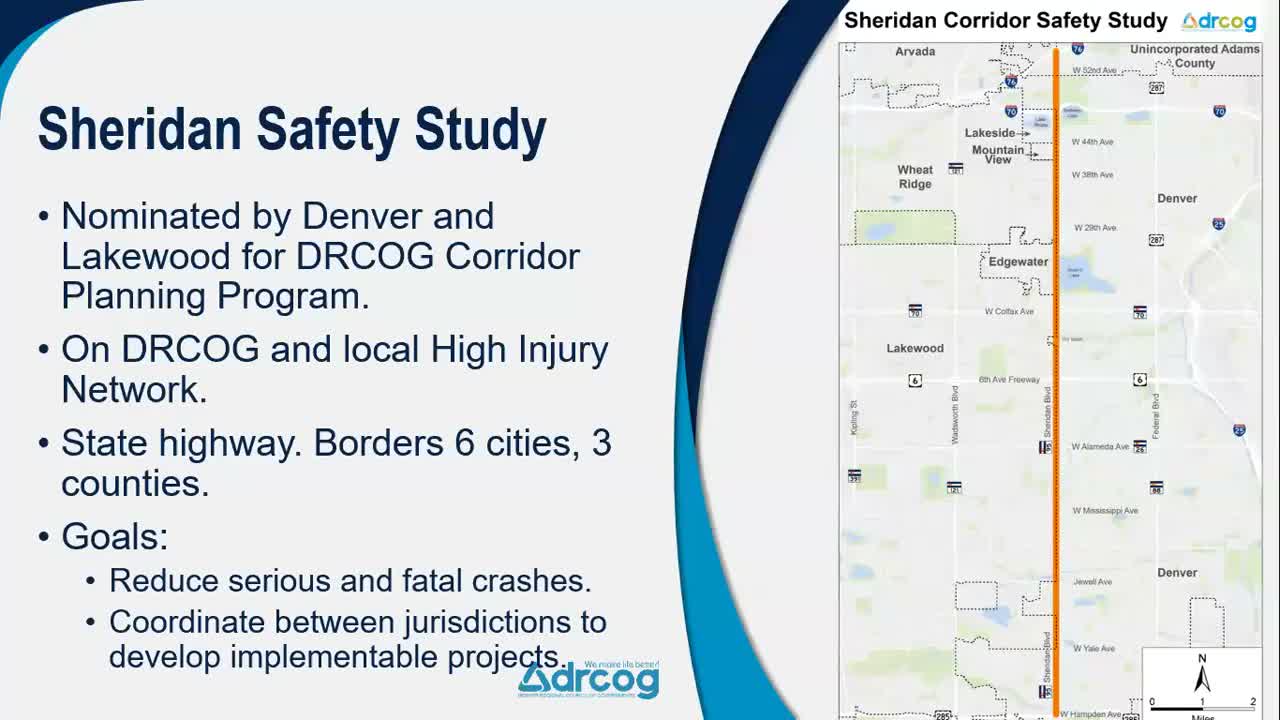
Summary
DRCOG’s Sheridan Corridor safety study found more than 4,000 crashes from 2018–2022, including 152 serious injuries and 17 fatalities; recommendations include multimodal lighting, median or hardened centerlines, signal timing, sidewalk improvements and bus stop consolidation across a multi‑jurisdictional corridor.
DRCOG staff presented the final Sheridan Corridor safety study identifying concentrated serious and fatal crashes and a slate of recommendations to reduce life‑altering collisions.
Nora Kern, program manager for subarea and project planning, said over the five‑year study period (2018–2022) the corridor recorded more than 4,000 crashes, 152 serious injuries and 17 fatalities, with serious crashes disproportionately involving pedestrians, bicyclists and motorcyclists. “We were really focused on the serious and fatal crashes,” Kern said, noting those collisions were overrepresented among non‑occupants.
Key recommendations include targeted multimodal lighting, installing medians or hardened centerlines to reduce broadside and approach‑turn collisions, coordinated signal timing, sidewalk infill where feasible and bus stop consolidation. The study identified 26 intersections with recommended treatments, prioritized early actions, and produced conceptual designs and cost estimates for several near‑term projects.
Kern highlighted coordination challenges because Sheridan runs through multiple jurisdictions and much of the right of way is state‑owned; DRCOG’s role was to convene agencies, stitch together crash data from different police jurisdictions, and propose a coordinated implementation plan.
What’s next: DRCOG will work with local agencies to advance early action items, explore funding (including SS4 or other large grants), and convene police departments and jurisdictions for data sharing and joint implementation planning.