Lifetime Citizen Portal Access — AI Briefings, Alerts & Unlimited Follows
DARPA lays out rules, timeline for Lift Challenge; team applications open Jan. 5, 2026
Loading...
Summary
The Defense Advanced Research Projects Agency (DARPA) outlined rules, deadlines and technical requirements for its Lift Challenge during a webinar, including a Jan. 5, 2026 application launch, a 55-pound design threshold for streamlined certification, and FAA guidance for heavier systems.
The Defense Advanced Research Projects Agency (DARPA) used an online webinar to summarize rules, technical limits and key dates for its Lift Challenge and to answer participant questions about payloads, scoring and certification.
Donna, the webinar presenter, said the team application link will open on Jan. 5, 2026, and that one U.S. person or U.S.-registered entity must submit a team application and serve as the official team representative. Teams may include non-U.S. members unless those individuals are from countries on a U.S. Department of Defense restricted list; on-site attendance at the competition will be capped at 10 members per team.
Why it matters: DARPA framed the event as a deliberately difficult engineering contest meant to surface payload-carrying concepts that could affect both military and civilian logistics. The contest prioritizes the payload-to-aircraft-weight ratio rather than absolute lifted mass, and organizers said the format and rules are designed to balance safety, broad participation and a path to FAA certification.
Key rules and schedule Donna said teams should expect three milestone windows: a January draft concept paper (contents to mirror FAA certification submissions), March submission of build photos to show progress, and a May deadline for flight-test video verification, the final concept paper and proof of FAA certification. Selected teams that meet those deliverables will receive formal invitations to compete in June 2026.
Design and performance constraints include a total aircraft-plus-payload weight kept under 55 pounds where possible to enable faster testing under FAA Part 107 rules; allowed aircraft transformations between vertical and horizontal flight; a required vertical takeoff and landing from a 5-foot-radius zone for controllability assessment; and an operational altitude limit of 350 feet ±50 feet during attempts. DARPA said lighter-than-air concepts that use gas for lift are not permitted for reducing aircraft or payload weight, though gases may be used for propulsion and control.
"This is a DARPA challenge. It's not supposed to be easy," Donna said, adding that organizers set the 55-pound threshold to ease part of the FAA certification process without removing the technical challenge.
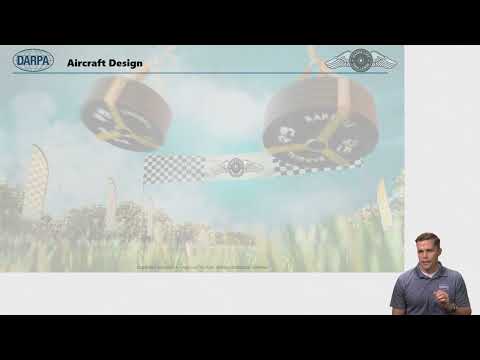
Payloads and telemetry DARPA will supply standard barbell-style weight plates as the challenge payload, in increments of 45, 35, 25, 10, 5 and 2.5 pounds. Plates must be collocated on the vehicle (not structural elements) and may be released together or in groups if safety is preserved.
Teams must carry two trackers: an FAA flight ID on the aircraft (teams must supply this) and a DARPA-provided payload tracker that will be shaped like a weight plate and count toward the payload weight. Donna said DARPA will specify that tracker’s mass in advance.
Course, scoring and attempts The competition layout will be a geo-fenced loop roughly 50 feet wide and about a quarter-mile long; teams must complete the outbound 4 nautical miles before a payload drop and then complete a final unloaded 1 nautical mile back to the takeoff/landing zone. Time for an attempt begins when the payload leaves the ground and ends when the aircraft lands after the final unloaded mile; infractions (failure to meet mileage, altitude or landing-zone criteria) invalidate that specific scoring attempt but do not reduce prior scores. Teams may attempt multiple flights during their assigned windows.
DARPA said the public will be invited to the outdoor event and that, depending on registration levels, the challenge may be collocated with Flight Test's Flight Fest in Malvern, Ohio. Josh Bixler, president of Flight Test, told attendees his organization expects to provide typical festival amenities such as food, camping and shuttles.
FAA certification and heavier aircraft Donna reiterated that operations under 55 pounds should comply with FAA Part 107 (pilot certification, registration, airworthiness) and that operations above 55 pounds require coordination with the FAA under a 44807 summary grant or similar special authority. She urged teams to submit FAA paperwork well in advance because certification timelines can be lengthy.
Participation, IP and funding DARPA will not provide direct funding to teams, Donna said, but organizers will open a U.S.-based contributor portal to let companies sponsor or donate materials to teams; DARPA will not mediate those private arrangements. DARPA also said it will not claim intellectual property that teams bring to the event, and teams are free to pursue patents.
Q&A highlights - On payload touchdown: Donna said a short, controlled drop after a safe landing does not count as an infraction if safety is preserved. - On "single point" payload collocation: DARPA clarified that plates should be colocated in a single zone rather than spread around the vehicle; they need not share a single attachment point. - On ejecting mass: teams may jettison expended energy sources but may not eject any part of the flyable aircraft; all flyable components must be carried for the return leg. - On refueling/charging: teams cannot add energy after the payload drop to complete the final mile; receiving personnel can remove the payload and assist transformation but not supply fuel or power.
What’s next Donna said organizers will publish a DARPA Lift Challenge–specific FAA checklist and the contributor portal link ahead of the Jan. 5 application launch. Teams that meet submission milestones in May can expect invitations to compete in June 2026.
Speakers quoted in this article are identified by their names and roles as they appeared in the webinar: Donna (presenter), Josh Bixler (president, Flight Test) and Anne (staff member running Q&A).