Get Full Government Meeting Transcripts, Videos, & Alerts Forever!
Get email alerts on the Septic Variance topic
No spam. Unsubscribe anytime.
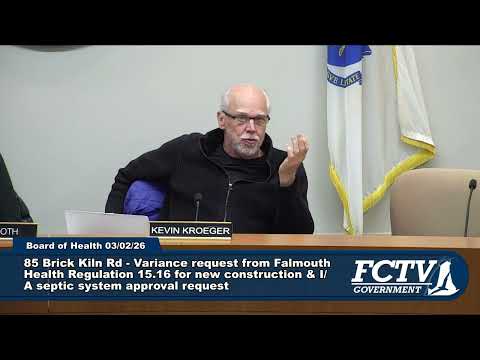
Falmouth board approves septic variance for 85 Brick Hill Road with strict monitoring and manufacturer support conditions
Summary
The Falmouth Board of Health approved a variance allowing an amphidrome plus septic system for a 40‑unit rental at 85 Brick Hill Road, contingent on monthly certified‑lab monitoring for at least two years, an in‑process DEP banner application, and written manufacturer/operator assurances of support and liability acknowledgement.
The Falmouth Board of Health on March 2 approved a variance to allow an amphidrome system with amphidrome plus polishing technology for a proposed 40‑unit rental at 85 Brick Hill Road, contingent on monitoring and written assurances. Tim Santos of Merrill Engineers told the board the manufacturer has submitted paperwork to the Massachusetts Department of Environmental Protection and that the system can reach the town’s standard of less than 10 milligrams per liter of total nitrogen when designed and operated properly.
Board members said the variance should include firm performance safeguards. George, a board member, urged caution about approving technologies with limited local data and proposed conditions to limit risk: "it would probably be a pilot under their situation" and the board should require "monthly monitoring in a certified laboratory" for an initial period. The board adopted those conditions, and added a requirement that the applicant provide documentation that the technology owner will support the operator and that the owner understands financial/liability responsibilities if the system fails to meet the town’s standard.
The motion to allow the system — made by George and seconded by a committee member — followed extended technical discussion about past local installations, operator performance and precedent. Tim Santos emphasized the difference that an experienced operator can make: he said he had seen amphidrome systems operate between 3 and 5 mg/L with appropriate design and management. The board noted the developer will be responsible if the system does not meet regulatory limits and that the board or state could issue enforcement orders if necessary.
Why it matters: Falmouth is in a nitrogen‑regulated area; adding approved, effective on‑site treatment options can expand development choices but carries water‑quality risk if systems are not monitored and maintained. The board tied this variance to specific reporting and manufacturer/owner commitments intended to reduce that risk.
The board approved the motion at the meeting and asked staff to track DEP’s banner listing progress and to receive copies of manufacturer communications as part of the approval conditions. If monitoring shows the system does not meet the <10 mg/L requirement, the board reserved the right to require remediation or pursue enforcement action.