
Council adopts annexation for Delaware Street parcels, clearing path for 173‑home Lennar community
Get AI-powered insights, summaries, and transcripts
Subscribe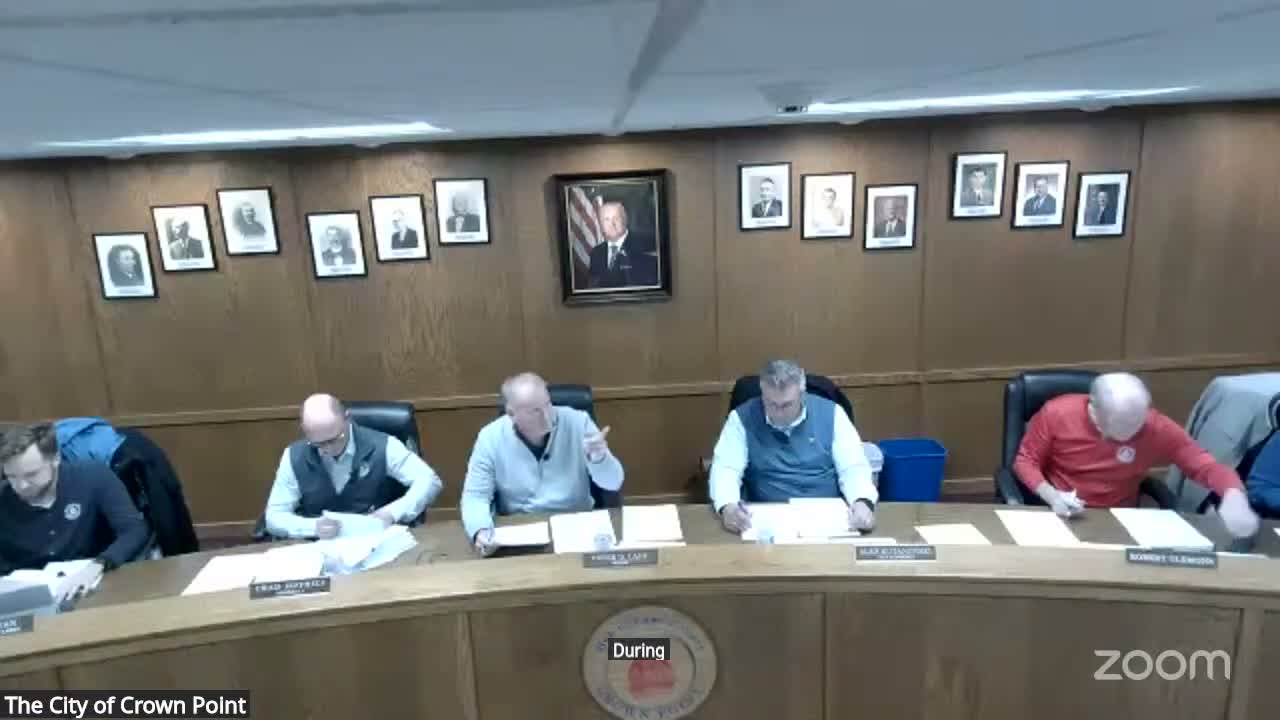
Summary
The Crown Point City Council on March 2 approved annexation and related fiscal-plan resolution for parcels along Delaware Street to allow a 173‑home development by Lennar Homes, after a developer presentation and public hearing in which neighbors raised concerns about traffic, stormwater, and loss of rural character.
The Crown Point City Council voted March 2 to adopt an annexation ordinance for parcels along Delaware Street and approved an associated fiscal plan, clearing the way for a proposed Lennar Homes community of 173 single‑family homes.
Attorney Jim Weiser, representing the petitioner, introduced the proposal and said the development team intends to file for subsequent zoning and plan‑approval steps if the annexation is approved. Todd Klevin, vice president of land for Lennar Homes, told the council the project would include three product lines — smaller homes on the east side (starting around $440,000), midrange homes in the $500,000s and about 21 estate lots on the west side (estimated near $600,000). Klevin said the project will require roughly a 2,800‑foot extension of water main and sewer down Delaware and estimated the early years of buildout would generate about $2.2 million in building permits and capacity fees.
Greg (FSG), the fiscal analyst, presented the fiscal plan that accompanied the annexation petition. He said his analysis assumes phased buildout and an "excess levy" appeal to capture incremental property tax revenue; the plan projects the annexation will have a positive bottom line once the development is built out (the report shows net positive results by year five, per the consultant's presentation). He also noted the analysis focuses on recurring revenue and recurring noncapital costs and does not attempt to model long‑term replacement of utility or road infrastructure beyond the budget year assumptions.
During the public hearing, several nearby residents urged the council to preserve the area's large‑lot, low‑density character and pressed the council to ensure adequate studies of stormwater, wetlands and traffic. Fred Osterhoff, who said he lives on Delaware Street, urged the council to consider the "long term impact this annexation will have on the surrounding community" and suggested the area is better suited to larger, unincorporated lots. Other speakers raised similar concerns about wildlife, wetlands, increasing traffic and whether municipal services and roads can absorb more development.
Council members asked the developer and staff questions about minimum lot widths, whether the developer would commit to lot‑width minimums or zoning commitments, and how long‑term maintenance and capital costs (roads, utilities) would be managed. The petitioner said it would not propose lots narrower than 75 feet as a baseline and described options — zoning commitments or pursuing variances through the board of zoning appeals — for any smaller lot requests. Staff confirmed that annexation is the necessary first step and that zoning and plan‑approval would follow before building permits are issued.
The council moved to adopt ordinance 2026‑02‑05 on second reading; the motion passed (roll call recorded as five yes votes). The related fiscal plan resolution (2026·03·01R) was also approved earlier in the meeting to allow the annexation to proceed through the zoning and planning process.
Next steps: the annexation now permits the petitioner to move forward to plan commission and zoning proceedings; specific lot layouts, final infrastructure plans, and any variances will be considered in subsequent hearings and permit reviews.