
Advisory committee recommends the 2025 roadway impact fee study update after questioning large increases in maximum fees
Get AI-powered insights, summaries, and transcripts
Subscribe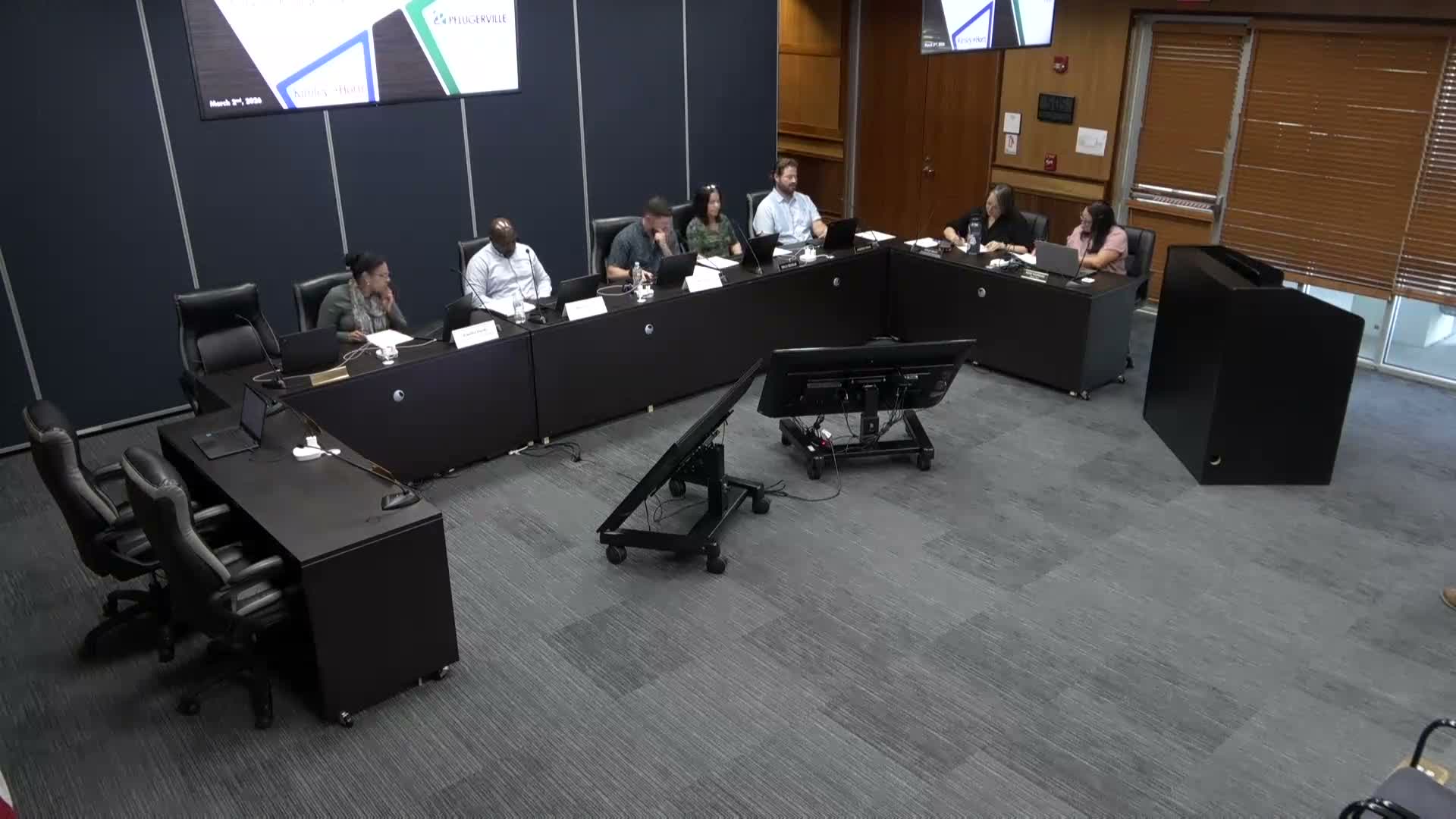
Summary
An advisory Boards and Commissions meeting reviewed the 2025 Roadway Impact Fee Study update, focusing on why maximum assessable fees rose (construction-cost escalation and a costly frontage-road ramp), how fees apply across service areas and ETJ, the interaction with TIAs, and voted to recommend the study to city council.
An advisory Boards and Commissions panel reviewed the City’s proposed 2025 Roadway Impact Fee Study update and voted to recommend the study to city council after extended questions about sharply higher maximum assessable fees.
Ben Plaid, who said he prepared the update, told the committee the study sets the ceiling for fees — “this is the ceiling,” he said — and that city council would decide what collection rate to adopt. Plaid said the update recalculates fees based on current project costs and growth assumptions; most maximum fees rose compared with the 2020 study, though the currently adopted collection rates remain below the new maxima.
Committee members pressed Plaid on why some ceilings more than doubled. Plaid attributed most of the increase to general construction-cost escalation and inflation since 2020, and pointed to at least one project where estimates rose substantially: a ramp project for the FM 45 frontage road that was conceptualized at roughly $10,000,000 in the prior study and is now estimated near $25,000,000 in current cost assumptions. Plaid said those shifts — combined with updated unit bid prices and a refreshed CIP — drive much of the recalculation.
The group discussed how fees are applied. Plaid explained the maximum assessable fee is the CIP cost divided by expected growth over 10 years, corrected so new development pays only for capacity that serves that new growth. He described a worked example using trip-generation and a capped search radius (six miles) that produced a per‑unit figure discussed during the meeting (participants verbally referenced a figure near $6,812 in the exchange). Plaid repeatedly emphasized the study establishes a ceiling; the council sets the collection rate and could elect to keep the current lower rates.
Committee members also asked whether impact fees can be used in already built-out areas. Plaid and staff said yes, but only for projects that add capacity — not for projects that merely reconstruct existing lanes. The committee discussed how service-area boundaries and extraterritorial jurisdiction (ETJ) affect charges: fees apply only inside city limits, and properties in the ETJ would not be charged until annexation; when a site straddles city limits and ETJ, the fee is prorated (for example, a site half in city limits could be charged roughly 50% of the full fee in the presented example).
Members debated trade-offs between raising collection rates (shifting costs to developers) and funding roads through other revenues (taxes, bonds, grants). Several members said they worried high collection rates could make the city less competitive for development and could hurt small commercial prospects such as restaurants; others noted voter-approved bond funding already commits dollars to major roadway work.
The committee also raised legal and procedural questions about requiring both traffic impact analyses (TIAs) and impact fees, expressing concern about “double dipping.” Matt Recker, utilities director and director of development engineering, explained typical local practice: both tools can coexist, and the city uses mechanisms such as developer credits and cost-participation agreements to avoid charging developers twice for the same improvement. He said impact-fee analyses are high-level and prospective, while TIAs are site-specific; when a developer is required to build a project already on the CIP, the city typically credits that work against impact-fee liability.
At the meeting’s end the committee voted to recommend the study to city council for review. Chair called for a voice vote; the committee approved the motion after Andrew moved and Marcus seconded. The committee recorded the motion as passed by voice and adjourned at about 5:42 p.m. The study, its land‑use assumptions and CIP will be available for council consideration and the committee encouraged members to include written comments to council if they wish.
The committee’s recommendation is advisory; council retains authority to select a collection rate and to adopt any fee schedule up to the maximum the study calculates. The study contains detailed worksheets for service areas, sample calculations and the capital projects assumed in the fee model. The committee did not record individual roll-call votes in the transcript; the voice vote was recorded as affirmative and the motion carried.