Get Full Government Meeting Transcripts, Videos, & Alerts Forever!
Get email alerts on the Tax Rates topic
No spam. Unsubscribe anytime.
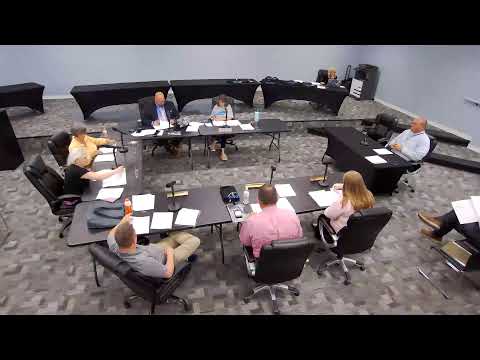
Spencer County Schools staff outline tax-rate options, warn of revenue trade-offs ahead of Aug. 26 deadline
Summary
At an Aug. 13 work session, district financial consultant Mister Murphy briefed the board on statutory deadlines, rate options (compensating, 4% revenue-increase, subsection 1, House Bill 940), and the local revenue impact; net new property dropped sharply and 118 properties moved to Shelby County rolls, a shift Murphy said will affect district revenue.
Mister Murphy, the presenter for the district, told the Spencer County Board of Education on Aug. 13 that the district has 45 days from certified assessments to set tax rates and that missing the deadline would let the compensating rate take effect automatically. "The plan is for that to be done in two weeks on August 26," he said. "If they're not set by that time frame, then the rate automatically becomes the compensating rate."
Murphy walked board members through commonly used options: the compensating rate (produces the same revenue as the prior year), the 4 percent revenue‑increase rate (the state’s commonly used revenue target), the rarely adopted subsection 1 rate and the House Bill 940 (tier 1) rate, which is the lowest threshold for SEEK funding participation. He emphasized the 4 percent option is a revenue target, not simply a 4 percent increase in the numerical tax rate. "That is the 4% revenue increase rate. It is not the rate that is 4% higher than it was last year," Murphy said.
The presentation included district figures: Murphy said last year's real-estate levy for Spencer County was about 60.1¢ per $100 of assessed value (including a 0.1¢ exoneration allowance), the compensating rate computes to roughly 57.5¢, and the 4% revenue-increase rate would be about 59.8¢. He told the board the exoneration allowance for this year is 0.2¢ and that adopting it is expected to generate roughly $39,000. "Just think what a teacher or a school or whoever can do with $39,000 in this district," he said.
Murphy highlighted a sharp swing in net new property: a recent year showed about $77.8 million in net new property, while the current year is around $14.4 million, a substantial drop. He attributed part of that change to a boundary/roll adjustment with Shelby County, saying roughly 118 properties representing about $33.1 million in assessed value moved from Spencer to Shelby County tax rolls and that the district took the PVA values for those properties as reported. The board did not receive a contesting figure in the meeting; Murphy said he had not reassessed those properties himself.
Murphy also put the revenue stakes in budget context: property and utility taxes produce roughly 30 percent of the district's general-fund budget. He showed model scenarios where choosing the compensating rate instead of the 4% option could mean a recurring revenue difference (his example cited about $437,000 annually), a figure he contrasted with recent recurring general‑fund salary increases. "A loss of $437,000 would mean that that has to be made up some other way," he said.
Murphy explained the recall process for rates above 4% and said the Kentucky Department of Education advised the district that the newspaper advertisement is no longer strictly required; the district will publish the notice anyway for transparency. He concluded that the board will return to set a rate at the Aug. 26 meeting and that a formal tax hearing will be held as part of that board session.
Next steps: the district will advertise the potential rates and hold a tax hearing at the meeting where the board finalizes the levy on Aug. 26. The board did not take a vote on the tax rate at the Aug. 13 work session.