Get Full Government Meeting Transcripts, Videos, & Alerts Forever!
Get email alerts on the Pavement Management topic
No spam. Unsubscribe anytime.
Mansfield staff present five‑year pavement plan after citywide survey shows strong network condition
Summary
Consultants told Mansfield City Council the city's network PCI is 77 with just 1% backlog; staff presented budget scenarios showing maintaining current conditions would require about $13 million annually when combining maintenance and capital work, and recommended continuing a balance of reconstruction and preventive maintenance.
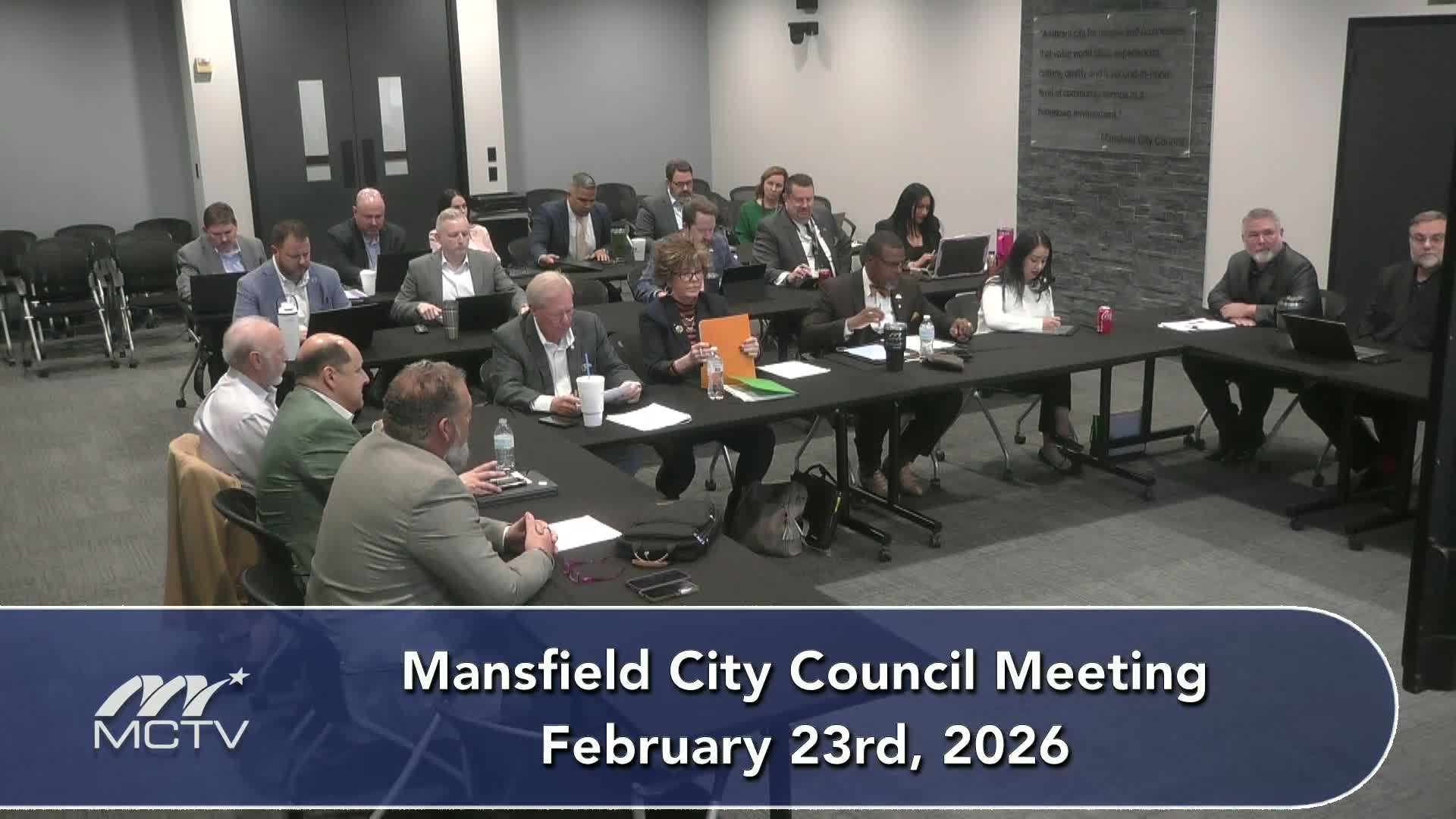
Mansfield's pavement network earned an overall pavement condition index (PCI) of 77 in a citywide survey presented to the City Council on Feb. 23, 2026, with consultants reporting a backlog — the share of the network at reconstruction‑candidate condition (PCI 40 or below) — of just 1 percent.
The presentation, led by Megan Ratliff, an engineer with ICCIMS, explained that PCI is a standardized 0–100 score that captures distresses such as alligator cracking, corner breaks and raveling. Ratliff said a score of 100 indicates a nearly new roadway and that the city uses PCI thresholds (notably PCI ≤40) to identify segments likely to require reconstruction rather than lower‑cost maintenance treatments.
Ratliff and city staff showed representative photos tied to PCI scores and walked the council through modeled five‑year budget scenarios. Under the “steady state” scenario — the annual investment needed to hold the city at roughly its current condition — the combined maintenance and capital requirement was estimated at about $13,000,000 annually. With the city’s current maintenance budget, the model projects a modest decline over five years but also projects a backlog near 0 percent because capital projects have reduced the worst segments, Ratliff said.
Council members pressed staff on how PCI is aggregated, how age versus observed condition is treated and how priority decisions will intersect with safety studies. City staff said PCI is calculated per GIS road segments (typically block‑to‑block), that age is a factor but not the primary input, and that the PCI assessment is one tool among others — including transportation safety and accident history — when ranking projects for capital funding.
Staff demonstrated an interactive mapping tool that links segment‑level PCI scores with recommended treatments and said the city aims to incorporate the survey data into its asset management system so updates after repairs can be reflected more quickly. Ratliff recommended a mix of preventive maintenance (targeting higher PCI ranges to slow deterioration) and targeted reconstruction for the small share of very poor segments.
The council expressed general satisfaction with the results and asked staff to provide ongoing updates; staff said the survey can be rerun or updated annually as projects are completed to refine the five‑year plan.
The council took no formal policy vote at the presentation but will use the results when building the upcoming maintenance and capital budgets.