Get Full Government Meeting Transcripts, Videos, & Alerts Forever!
Get email alerts on the Strategic Plan topic
No spam. Unsubscribe anytime.
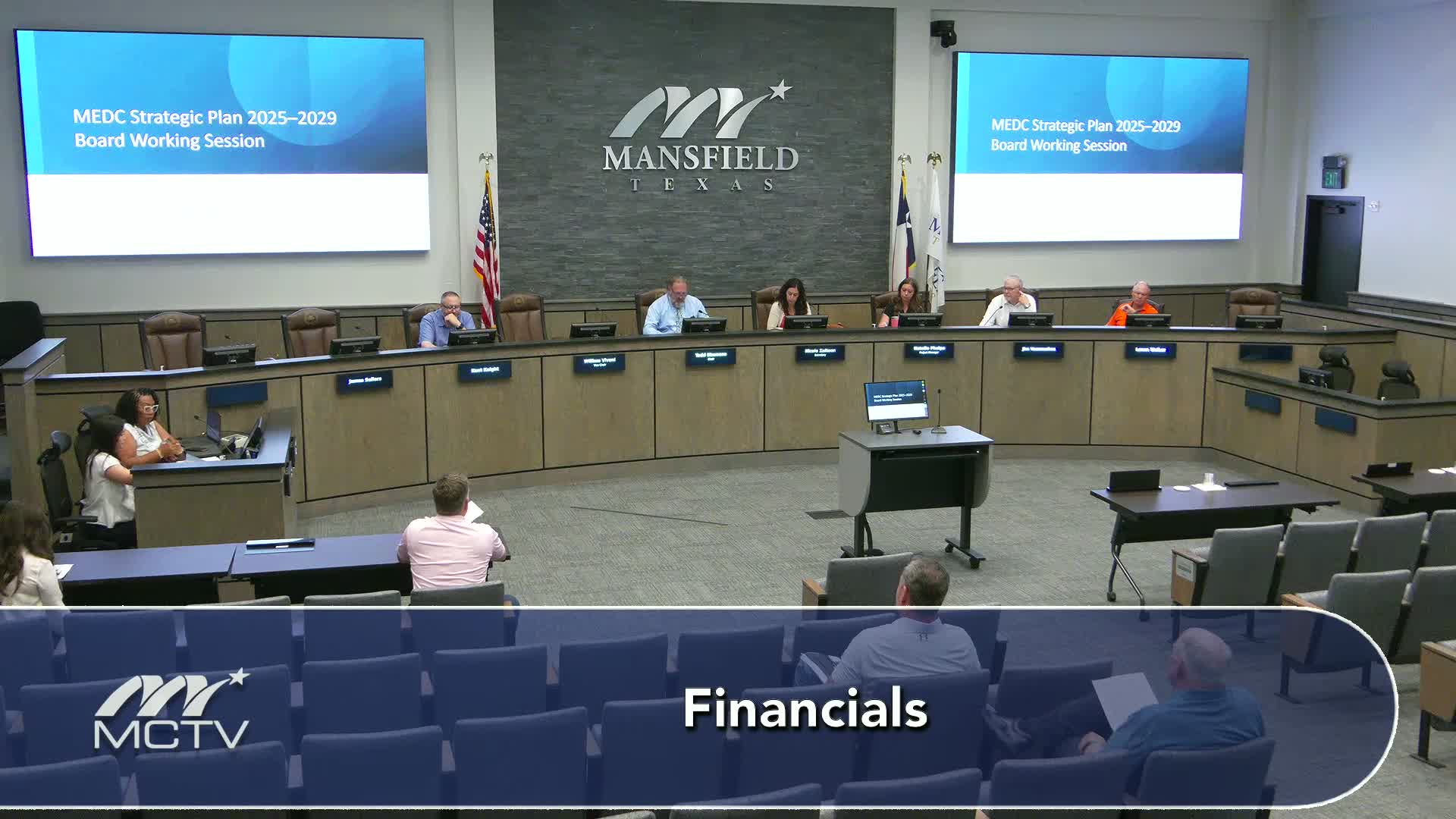
Mansfield EDC reviews 2025–29 strategic plan, weighs workforce needs and land limits
Summary
At a June 3 work session, Mansfield Economic Development Corporation staff presented a draft 2025–2029 strategic plan tied to a biennial tax-abatement review. Board members urged clearer trade-area metrics, explicit higher-education goals and careful use of incentives given limited land and financing volatility.
The Mansfield Economic Development Corporation board met June 3, 2025 for a work session to review a draft 2025–2029 strategic plan that staff said will align incentive policy changes required every two years with the city’s longer-term development goals. Jason, EDC staff, said the plan and policy updates are intended to be adopted by August after a joint workshop with city council.
Why it matters: The plan will guide how the EDC uses sales-tax-funded incentives — which staff said must meet standards such as capital investment, job creation and payroll thresholds — while the board weighs trade‑offs between recruiting high‑paying employers and preserving limited developable land.
Staff framed the review by describing the legal context and the EDC’s tools. “Tax abatements don’t have anything to do with EDC,” Jason said, noting the state comptroller requirements and that tax-abatement policy language and the EDC’s incentive toolbox (Chapter 380 grants, rebates, performance-based abatements) need periodic reauthorization. He asked the board for feedback on the plan’s SWOT analysis, target industries and proposed goals.
Board members pressed for more specificity on several items. One member questioned listing “strong income” as a blanket strength, arguing the city’s trade area can look different at longer drive times. “The strong income jumped out at me a bit because…they all look at a 25‑mile radius,” said a committee member, urging the staff to differentiate by trade area and industry.
Jason agreed and offered trade-area context: within a 10–15 minute drive the median income looks strong (he cited about $116,000), while at a broader 20‑minute drive-time the median drops toward roughly $67,000. He recommended refining plan language to reflect the difference by industry.
Workforce and higher-education linkages were recurring themes. A board member urged pursuing satellite university programs tied to employers such as the Super Studios project, and staff outlined existing partnerships with Texas Tech, Texas A&M and Tarrant County College to bring certification and pipeline programs to Mansfield. “We’ve been working very closely with our educational partners…Ben Barber Innovation Academy has put 400 students through [a CNC program],” a staff member said.
Secretary Nicole suggested explicitly listing higher education among target industries to help attract professional-services and graduate programs. Other members proposed using underutilized off‑hours in local buildings (schools, churches) to host training as a low-cost option to expand capacity.
The board also discussed constraints that will shape the plan. Members and staff noted limited remaining developable land (staff estimated roughly 20% left) and the erosive effects of regional competition and macroeconomic volatility (interest rates, material costs) on project feasibility. Jason said the EDC maintains conservative reserves and uses outside consultants (Baker Tilly for pro forma review; Hilltop Securities for financial advising) to vet deals and protect taxpayers.
On incentives, staff reiterated a policy focus on demonstrable need: incentives should fill a defined “but‑for” gap rather than simply outbid neighboring jurisdictions. Staff also described downtown programs such as the Neighborhood Empowerment Zone (NEZ), which waives many development fees for qualifying single‑family and commercial downtown projects under a three‑year pilot and excludes multifamily fee waivers.
Staff highlighted five draft goals: cultivate innovation and industry growth; revitalize downtown; expand tourism and quality of life; foster small business and entrepreneurship; and enhance infrastructure and development readiness. Projects in the pipeline cited by staff included the Mansfield Innovation Community (Admiral Legacy office), the Stable Street stadium (on schedule, steel erection imminent) and a canals mixed‑use agreement with Stillwater Capital that awaits the governor’s signature on a municipal management district financing mechanism.
Jason outlined a two-track outreach plan and marketing budget limits: EDCs may spend up to 1% of annual revenue on promotions (approximately $100,000 for Mansfield), and staff described a mix of brand‑awareness work and targeted broker and national outreach that will shift to more call‑to‑action content in the fall.
Next steps: staff will incorporate board feedback into another draft and circulate it before a joint meeting with city council (a June 23 date was listed as tentative) and will seek final adoption in August. The board unanimously approved routine minutes and adjourned at 6:38 p.m.
The meeting transcript shows the work session focused on aligning incentive policy with strategic goals, clarifying metrics for trade areas and industries, strengthening higher‑education partnerships and guarding against over‑committing incentives as projects multiply.