
Petersburg Borough reviews alternative sites, FAA lighting and timelines for proposed broadband towers
Get AI-powered insights, summaries, and transcripts
Subscribe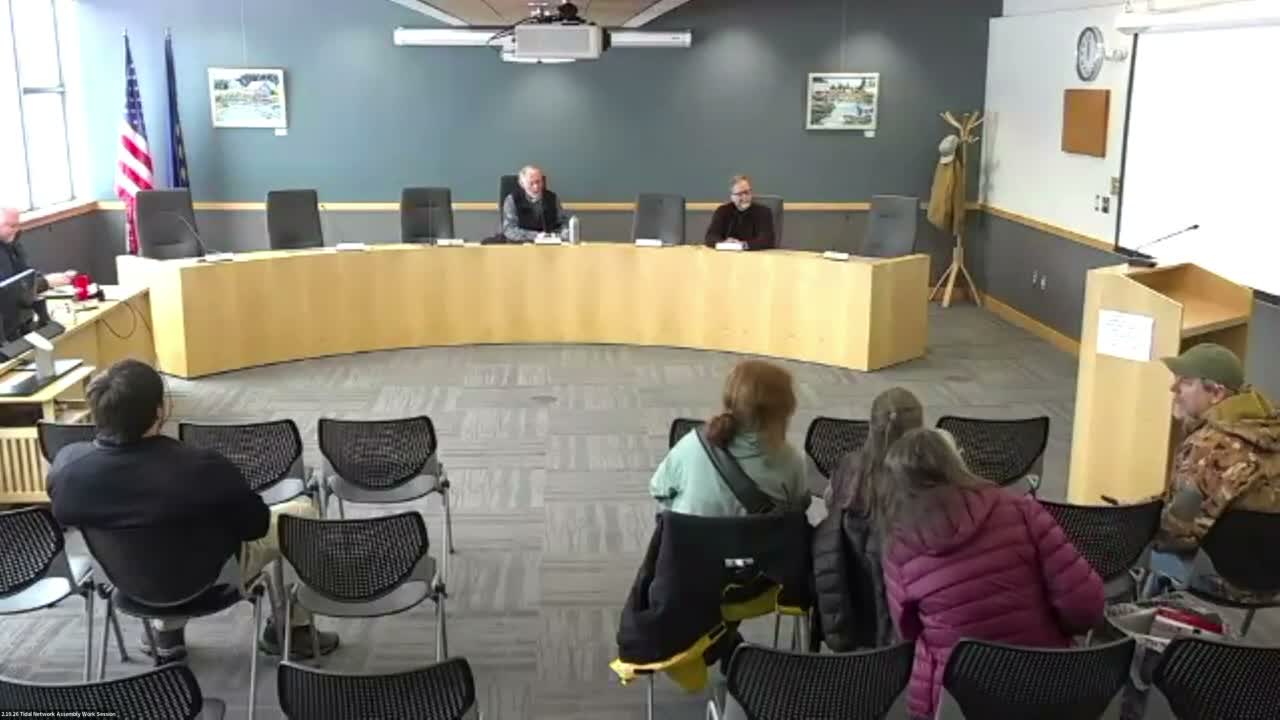
Summary
At a borough work session, Title Networks reviewed mapped candidate parcels for a proposed tower network including Rory's Road, Mental Health Trust and DNR land and private parcels; the assembly pressed on FAA lighting rules, construction costs and a tight grant timeline tied to a possible no-cost extension.
Chris Cropley, director of Title Networks, told the Petersburg Borough assembly at a March work session that his team has been mapping four candidate search zones for proposed broadband/cell towers and that some pins on their internal maps are legacy markers not under active consideration. “I just want you guys to understand that we have some legacy stuff on there,” Cropley said, adding he would walk the assembly through current pins before the group made any assumptions.
The presentation focused on alternatives to the Rory’s Road site that Cropley had previously proposed, including parcels owned by the Alaska Mental Health Trust, state Department of Natural Resources (DNR) land and private parcels near an existing FM tower owned by Matt Garrett. Cropley said state or trust land can be useful but typically takes far longer to acquire: “Getting the state to sell us land that isn't for sale doesn't fit in our timeline,” he said, noting prior negotiations with state entities have taken a year or more.
The borough’s Steve Giesbrecht confirmed that the borough has worked with both the Mental Health Trust and DNR and that there are formal processes for acquiring property but cautioned those processes can be slow. “If you've got a time frame on this, that's gonna impact your conversations with both DNR,” Giesbrecht said, emphasizing past projects that required multi-year efforts.
Assembly members explored private alternatives as a potentially faster path. One member pointed to land adjacent to an existing private FM tower and noted that private parcels with existing road access might move faster than state transactions. Cropley agreed, calling privately owned parcels “something to think about” for quicker delivery.
Technical constraints were a recurring theme: members asked about power availability and radio-frequency coverage, and Cropley said sites must have accessible power and undergo RF analysis because distance alone does not determine signal quality. The team’s consultant, Trevor Newton, summarized a key aviation-related technical constraint: the FAA’s rule-of-thumb for when tower lighting may be required is roughly 200 feet in height. “The general rule of thumb is 200 feet,” Newton said, and he noted that prior filings for candidate sites such as Haugen Drive, Mill Road and Pappies did not require lighting.
Lighting generated the most sustained policy discussion. Cropley warned that federal guidance might compel high-intensity strobe lights on the tallest towers, which he and several assembly members said would be intrusive: “I feel like I'm gonna lose even more friends, if I go put on a giant Xeon flashing light,” Cropley said. Several assembly members suggested complying with the FAA minimums and leaving lighting out of Title Networks’ initial contract, so the assembly could amend the contract later if it chose to require lights. Giesbrecht said he planned to tell Title Networks to treat lights as optional in the current contract and allow the assembly to add them later if desired.
Cost and construction feasibility were also central. Cropley described the foundation and site work — not the tower steel — as the major cost driver, estimating a foundation could be about $600,000 “on a good day” and warning that deep muskeg and difficult soils near some candidate parcels would add substantial expense. One assembly member noted that building 700 feet of road in the fire-hall area could approach $1,000,000 depending on standards, and staff cautioned that access and geotechnical work frequently change budget expectations.
Cropley said the project timeline is tight because the team is working under a federal grant that currently runs through the end of the year; they are pursuing a possible no-cost extension but said the borough should not assume an extension will be granted. “Right now, I only have until the end of the year to get things done,” Cropley said, adding that extra time would allow the team to pursue state or trust parcels more comfortably.
Next steps recorded in the discussion included Title Networks arranging and pursuing meetings with DNR, the Alaska Mental Health Trust and DOT as needed; outreach to private landowners where road access exists; RF checks of candidate parcels; and continued work on the Rory’s Road parcel, including site cleanup. Cropley said crews would clean the Rory’s Road site and the team would return with refined analyses and options once the borough’s input and partner-agency responses are available.
The chair closed the work session after the group agreed to treat the lighting requirement as something for the assembly to add later and to allow Title Networks to continue site evaluations and outreach. The session ended with no formal action taken; all next steps were directional and investigative rather than binding.