
WSDOT outlines schedule and land needs for Belfair SR‑3 freight corridor; local partners stress economic benefits
Get AI-powered insights, summaries, and transcripts
Subscribe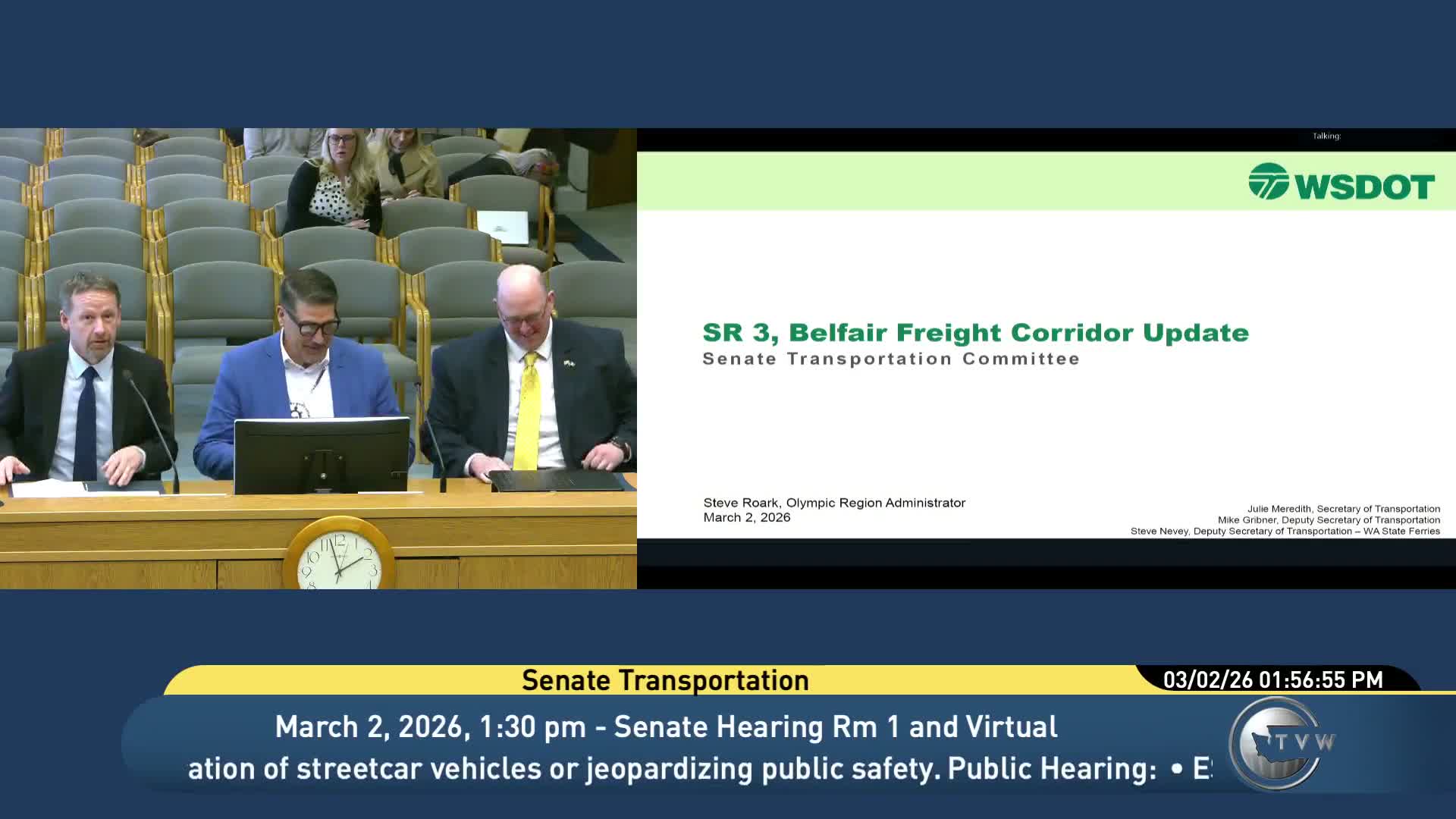
Summary
WSDOT told the Senate Transportation Committee the Belfair freight corridor is planned as a nearly 6‑mile limited‑access route, will require about 180 parcels for right‑of‑way, and could go to bid in late 2027 or early 2028 pending an access hearing and acquisitions; local and tribal partners emphasized regional economic and emergency‑route benefits.
Washington State Department of Transportation officials briefed the Senate Transportation Committee on March 2 about the Belfair Freight Corridor (SR‑3), describing project purpose, design elements and a tentative schedule tied to right‑of‑way acquisition.
Steve Rourke, Olympic region administrator for WSDOT, said the corridor is intended to provide a reliable regional route, reduce traffic on SR‑3 through downtown Belfair and improve freight mobility. The planned limited‑access alignment is about six miles of two‑lane greenfield highway with roundabouts proposed at key tie‑ins and two new intersections at SR‑302 and SR‑3 near the south end.
Rourke said the environmental review is complete and the next major step is an access hearing (targeted for July) that would allow WSDOT to begin right‑of‑way acquisition. "We have about 180 parcels we need to purchase to go to construction for this corridor," he said, adding that right‑of‑way negotiations are estimated at about 18 months and that construction, once under contract, would take about 2 to 2.5 years.
Funding cited in the presentation included an initial Connecting Washington allotment reported as about $79,000,000; Rourke said the agency will run a cost‑risk assessment this summer to update estimates and refine the fiscal picture.
Local economic partners told the committee the corridor supports housing growth and emergency routing. Kevin Schutte of the Mason County Economic Development Council said the corridor helps capture benefits from regional investments, citing more than 350 recent housing units in Belfair and the need for reliable routes for employers such as the Puget Sound Naval Shipyard.
Ryan Ramirez, CEO of Port Madison Enterprises (the Suquamish tribe's economic arm), framed the corridor as essential infrastructure for Kitsap County and regional naval and commercial investments — noting a cited NAVFAC Northwest projection of substantial construction contracting in the region through 2027 — and urged continued state support.
Committee members asked about staging impacts. WSDOT said most work is greenfield but tie‑ins near schools and neighborhoods will be pinch points during construction; a staging plan should maintain at least one travel lane in each direction though PM peak congestion is likely.
The presentation did not result in committee votes; members thanked presenters and the committee will monitor progress as the access hearing, right‑of‑way acquisition and cost‑risk assessment progress.