Get Full Government Meeting Transcripts, Videos, & Alerts Forever!
Get email alerts on the Administrative Approvals topic
No spam. Unsubscribe anytime.
Huntington Woods commission seeks broader staff authority for routine historic‑district work
Summary
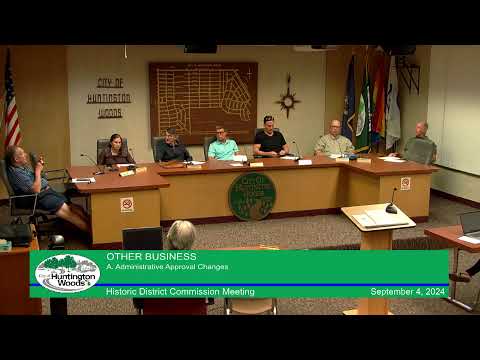
At its Sept. 4 meeting the Huntington Woods Historic District Commission instructed staff to redraft a proposal letting the zoning administrator approve routine repairs and historically compatible replacements administratively — from gutters and fences to windows and garage repairs — and return in October for further review.
HANK (staff) proposed a package of changes allowing the zoning administrator to grant administrative approvals for a range of routine repairs and replacements in the Huntington Woods Historic District, including gutters, fences, driveways, porches, windows, subgrade structures and security or charging equipment. Commissioners debated where to draw the line between items staff could approve and those requiring full commission review, and asked staff to redraft the language for an October meeting.
The proposal, introduced at the Sept. 4 meeting of the Huntington Woods Historic District Commission, was framed as an efficiency measure: staff said expanding administrative approvals would spare homeowners long waits when the commission lacks a quorum and reduce repetitive agenda items. "We had a lady that came before us for a privacy fence. We couldn't put together a quorum, had to postpone her for the next month," Hank said, noting that under Public Act 169 an application can be automatically approved after 60 days. He told the commission he wanted to add privacy fences that comply with Chapter 40‑10.1 of the city code to the administrative list so eligible applicants would not face that delay.
Commissioners pressed staff on criteria and safeguards. Committee member Steve asked whether owners of later, non‑historic alterations could replace those features with incongruous materials simply by claiming they were "what was there" before the district existed: "If I've got a seventies house with a k‑style gutter, and I wanna spruce it up and put copper gutters on, this language doesn't allow me to do that, is that correct?" Hank replied that staff would encourage returning to substantiated originals when feasible but cannot be "retroactively punitive" to owners who previously made changes; where a proposed administrative approval is not clearly appropriate, staff can refer the case to the commission.
A recurring drafting choice was whether to use the adjective "appropriate" or to require specifically that changes be "historically appropriate." Multiple commissioners recommended the narrower phrase. The commission signaled support for giving staff discretion to approve replacements when they "fit" the historic character, but several members insisted there must be an appeal pathway to the commission — and that items that alter streetscape (for example, newly covered front porches) should come before the full board.
Specific items discussed for administrative approval included driveway and walkway resurfacing that does not change routing or materials, replacement porches of the same size and style, window and storm replacements that preserve pattern/size/scale (with added guidance on glazing area), rear‑yard decks and patios, replacement light fixtures, and certain subgrade structures such as egress window wells. Commissioners also asked staff to add a separate line for security cameras and EV charging stations, with the devices required to be "visually compatible" or unobtrusive where they are visible from the street.
The commission debated tree removal language and the limits of local authority: staff reiterated that dead, diseased or dying trees can be removed administratively, while healthy trees in the historic district still typically require commission review. Commissioners also raised equity and cost concerns about historic‑district application fees; one member called the $300 application fee "overly onerous" for roughly 180 historic‑district households and asked whether costs could be redistributed across broader permit fees. Hank said staff costs (mailing, preparation, hearing time) explain current fees but that the fee structure could be reconsidered by the city commission.
No formal changes were adopted at the Sept. 4 meeting. Hank said he would redraft the administrative‑approval language incorporating the commission's direction (including use of "historically appropriate" in several places) and return to the commission at a scheduled October meeting. There was no public comment and the meeting adjourned by voice vote.
Next steps: staff will circulate a revised draft in advance of the October meeting for further review and formal action, if any.