Get Full Government Meeting Transcripts, Videos, & Alerts Forever!
Get email alerts on the Geyer Commons topic
No spam. Unsubscribe anytime.
Mansfield officials outline Geyer Commons timeline, vendor rules and $5.7M contract update
Summary
City staff updated the council on Geyer Commons construction and vendor plans, seeking direction on residency preference and approving a consent-agenda change order that would raise the contract to $5,735,759.46 to add mini‑split HVACs, electrical service and finish items.
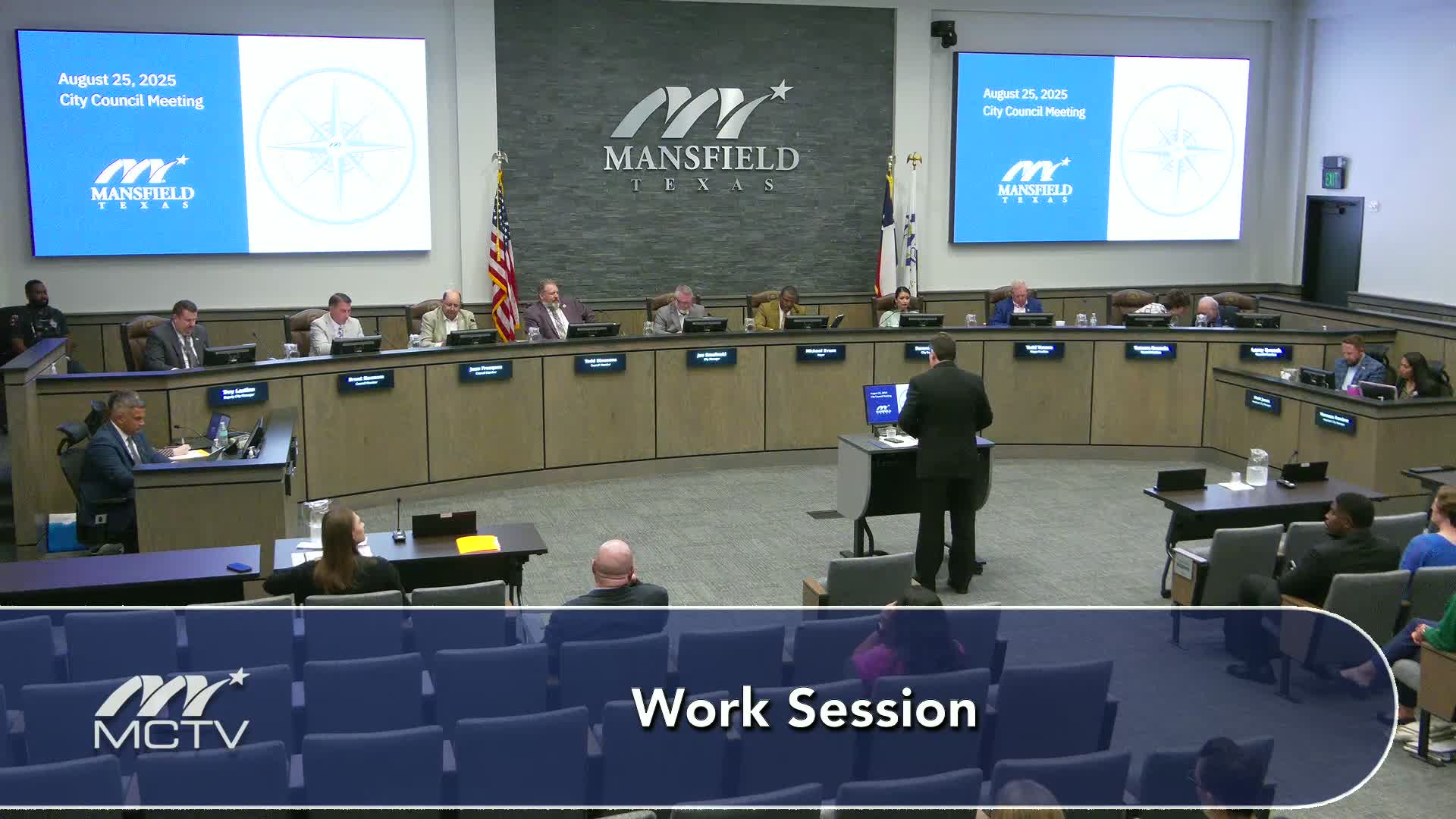
Matt Young, the city’s executive director of community services, told the Mansfield City Council on Aug. 25 that Geyer Commons — a new public gathering space in downtown with lawns, a splash pad, restrooms and 12 vendor cottages — is progressing and that staff had a number of items on the consent agenda related to its completion.
Young said recent site work shows vendor cottages and foundation work largely in place and that staff is seeking approval of Change Order No. 2, which would add $354,250.43 to provide a mini‑split HVAC unit for each of the 12 cottages, 100‑amp subpanels to support those units and electric and water service for festival islands. ‘‘This will provide a mini split HVAC unit for each of the 12 cottages,’’ Young said. With that change order the revised construction contract would be $5,735,759.46, he said; staff also reported approximately $65,000 of contingency remaining.
On operations, Young described proposed vendor rules and timelines: vendor cottages measure about 14 by 16 feet; staff proposes operating seasons (spring March–July and fall Sept.–Jan.) with five‑month lease increments, a $250 monthly rent and a $200 security deposit. Young said 47 applications had been received as of Aug. 20 (about 44 unique proposals after some partnerships), that 36% of applicants were Mansfield residents, and that staff aims to notify selected vendors by Oct. 3.
Councilmembers largely supported a residency‑preference scoring approach — giving Mansfield residents extra points rather than excluding nonresidents entirely — while urging staff to ensure a balanced mix of vendor types so the market is not all one product category. Several councilmembers said they favored limiting long‑term occupancy to preserve the cottages as incubator spaces; a common suggestion was a two‑year cap before a vendor must vacate for a period.
The council also debated alcohol sales at the cottages. City staff and the city attorney said alcohol sales are possible under state rules and contract terms but would require careful lease language and likely an RFP to contract a single alcohol vendor or limit sales to packaged or off‑site consumption. Several councilmembers said they preferred to reserve alcohol sales for larger historic buildings on the site or for off‑site/packaged sales, not open on‑site consumption in the cottages.
Staff discussed utilities and public safety systems: a city network connection and cameras will likely come online after Fire Station 1 is connected; staff proposed dedicated public Wi‑Fi and separate network paths for vendor point‑of‑sale devices and cameras. Young said parking on site and at nearby MISD lots should yield roughly 160–170 spaces.
Young asked for council direction on a residency priority and a proposed weighted scoring approach; council agreed that Mansfield residents should receive preference through scoring and that staff should manage thresholds to preserve a desirable product mix. Young reiterated the target of mid‑November construction completion for phase 1a, with soft openings for vendors in advance of a full season.
The council did not take a separate policy vote during the work session; the change order and other construction items appeared on the consent agenda later in the meeting.