Get Full Government Meeting Transcripts, Videos, & Alerts Forever!
Get email alerts on the Public Safety topic
No spam. Unsubscribe anytime.
Carrollton police say data-driven crime plan cut violent crime about 32% since 2024
Summary
Police Chief Robert Arredondo told the City Council that an intelligence-led, data-driven crime plan and staffing improvements helped reduce violent crime ~32% and total Part 1 crime ~28% versus 2024, and announced a real-time crime center and a Feb. 6 drone-first-responder installation funded by a grant.
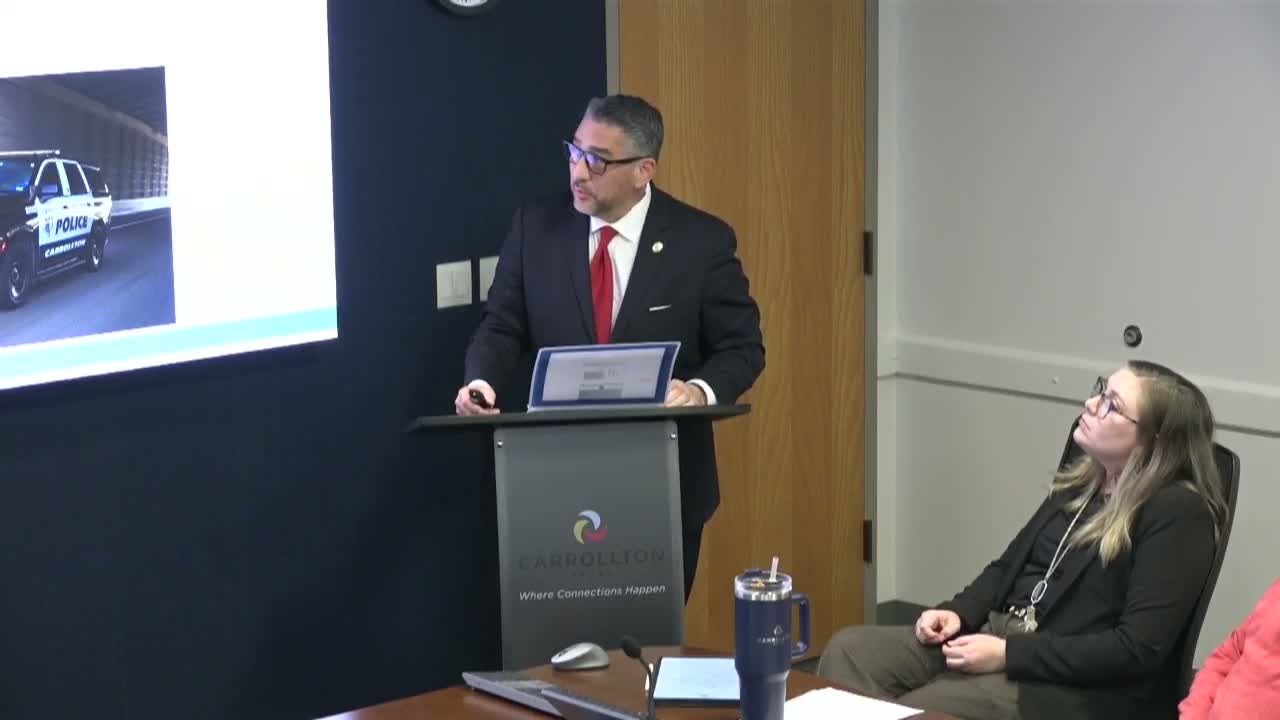
Carrollton Police Chief Robert Arredondo told the City Council on Jan. 20 that an intelligence-led, data-driven crime plan and targeted staffing changes have driven substantial reductions in crime over the past year.
Arredondo, speaking at a work session, said the department recorded a 32.1% drop in violent crime and a 27.9% decline in property crime when comparing 2025 to 2024, and cited a 28.3% fall in total Part 1 offenses. He credited an updated deployment model, more self-initiated policing and faster analysis of crime trends for the improvements.
The chief said the department replaced an older beat structure with four geographic divisions, introduced overlapping shifts to better cover peak hours, and shortened the cycle for crime-trend analysis from weekly to every six hours. "Less calls equals more unencumbered time is more productivity," Arredondo said, describing how the reorganization lets officers focus proactively on problem areas identified by analysts.
Arredondo described several staffing and recruitment initiatives—streamlined application processes, practice physical-agility sessions for recruits and social-media video reels aimed at improving outreach. He reported the force currently has three sworn vacancies and said promotional opportunities and retention efforts have helped fill many roles.
The department also rolled out a real-time crime center (RTCC) and a dashboard built with ArcGIS and Microsoft Power BI that officers can access in-station and in squad cars to view recent incidents, filter by location and assignment, and read incident narratives. Arredondo said the RTCC is staffed by analysts who feed near-real-time intelligence to patrol units.
RTC staff described an upcoming drone-first-responder capability scheduled for installation Feb. 6 in partnership with Farmers Branch and grant support. The program will place drones and a radar node on partner rooftops to provide rapid aerial situational awareness for incidents such as structure fires and traffic crashes. The city said the drones are overt tools intended for operational response and not covert surveillance.
Arredondo also said Carrollton has evaluated and contracted AI-powered tools for investigative information-sharing: the department recently added a system called BLTN to digitize and disseminate BOLOs, and participates in a multi-jurisdictional intelligence-sharing network. He said social-media monitoring and analytic tools are used by crime analysts when there are known events or threats.
Council members asked about the duration of grant funding for cameras and drones; Arredondo said the drone grant covers two years and that staff have contingency plans for sustaining equipment. He also committed to follow up with finance on budgeting for continued operations.
The council did not take formal action on the update; the presentation concluded with members praising the department’s reported reductions and the new tech investments.